The size of an ego

`His ego was too big for performing that menial task` is a statement that most of us have heard in one form or another. Whole schools of Eastern thought are focusing on the destruction of the personal ego. Yet, the ego has a function as well when we grow up. In addition, ego can contribute to a great creating force – as it can contribute to destruction.

Most observers I read (sorry for the cultural bias) depict Mr. Putin as having a large ego and Mahatma Gandhi as having a small one. In business however, ‘we’ value ego to the extent that usually it is needed by leaders to help drive an organization, yet ‘we’ value especially the leaders who are ‘not big enough’ to do small menial tasks. The perfect example being Walt Disney, who apparently would expect his top brass to also pick up litter when they walked through Disneyland Park. On the other hand, a total destruction of ego might lead to complacency and be quite unhandy in the next negotiation with a business partner.

Our Western world is focused on growing as a positive phenomenon, and a view of the ego that could grow ever more so that it could easily endure the ‘setback of humiliation’ might be more fitting this Western cultural setting.

Therefore, would it be a better expression of the typical Western culture to use the following phrase: “His ego was large enough that he could perform this menial task”?

Posted in Leadership | Leave a comment

Phases in a Project, Any Project

Whereas in a previous blog I focused on three essential phases every project passes through https://peteralderliesten.com/2015/04/21/fear-hope-and-satisfaction/, one can extend these phases to encompass virtually every single undertaking man endeavors: whether a 10k run, a 10k walk with children or a 10mil-project.

begin-25%

From the onset until about 5% of the project, “Starting Up”, there is fear, respect, and in some cases despair in how to achieve the goal. From 5% until about 25% of the trajectory, “Hopeful Plans”, there is plenty of hope since a particular route has been chosen, and all participants are looking forward to reaching the goal. For projects, this is generally the phase of writing the project plan, for vacation travels like the 10-15 hour drive from Amsterdam to The Riviera the phase where children are happily discovering the holiday colour book, the new DVD-player in the back of the car, or the new sweets that mom has purchased to buy off whining children.

25%-45%

After about a quarter of the trip, “The Dip,” despair sets in, since the mistakes in the preparation are becoming apparent: the sweets have been fully consumed, the DVD is not as interesting – or as long-lasting as hoped for, the project team really should have had an extra member with expertise in the local culture, and the blisters really make the completion of the run impossible. This moment is the ‘tough spot’ where people give up when they realize the daunting task laying ahead of them. (It would be interesting to check on which part of the marathon the most contenders give up, but that is something to be done in the future.)

45-65%

From 45-65%, or “Steady Progress,” the project team has found it’s way of working together, the athlete has found her rhytm and the rowing team is in tune with the ‘slagman’ and focusing on their strokes speeding forward. The little boys in the back seat have had their fighting the previous fifth of the trip and have now settled in a semi-peaceful coexistence awaiting to be kindled alive only by the next incident.

65-85%

From 65-85% (“Looking Back”) the realization sets in how far the Group has moved already: in the 25-45% part the focus has been on the road that still had to be travelled, in this part the focus is turned to what has already been achieved. One of the dangers here is that satisfaction sets in too early, so that the final part of the endeavour is hastily finished, leaving many essentials uncovered.

85%-completion

After 85%, the “Finishing Up,” the success is secured – or not – while resources are fleeting the athlete’s body she still has to go a significant distance; who does not know the searching for a hotel bedroom in the destination, the free tent or camper spot on a camping which seems elusive, or the hotel’s address which is not covered correctly in the TomTom, the apartment minder who is not at home while the dog in the back really needs to have it’s daily walk. Since the project has achieved it’s main objectives, parties left and right are already pulling on the project resources, and most sponsors really do not want you to spend that valuable time on a Lessons Learned: the next challenge is already awaiting!

Keeping the overview

The leader – be it a parent or a project leader – aware of the phenomenon above can use it to motivate the participants to move forward: any communication or bringing attention to ‘the process’ during “The Dip” is fundamentally going to have a disadvantage that the audience will have a negative basic outlook. Thus, any overenthusiastic communication fall flat. This is the time that communication needs to be realistic to keep ‘rapport’ with the audience. Sometimes it might be best to not communicate anything at all, like parents ignoring the whining in the back of the car.

One particular challenge in “Steady Progress” is a Steering Committee loosing interest since there are no apparent criseses requiring their immediate attention. That might be fine fort hat particular phase, but the danger is that there is no contact at all, so that after half a year project management is forced to draw the conclusion that the project is rudderless and the attention required for the decisions to be made in that phase can not be regained.

The link between Begin and End

The “Finishing Up”-phase has it’s own challenges, which need to be tackled already when “Starting Up”. Then the value of the Lesson Learned needs to be sold to the Sponsor to seed the acceptance of “Finishing Up”. In addition, resources need to be obtained and secured: that menas more than an informal “Yes, I will do it” but also from the higher up a (written) commitment that the resource will be available during the whole trajectory.

Then to make sure that the estimates of time required are also halfway decent is a challenge which deserves a book by itself.

Posted in project management | Leave a comment

A Dutchman in Frankfurt III – Europe

Europe is such a wonderful ideal.

Loss of insurance

In a previous blog I already apologized for being over-insured like any other Dutchman. When doing my taxes here in Germany I noticed that I paid a monthly amount to a Dutch insurer for some miniscule insurances, like liability, accidents etc. So, I tried to login to the online insurance portal and see what this was all about. The mandatory postal code verification of course caused my login to come to a screeching halt. I had to call the Servicedesk, and fortunately enough, their opening hours coincided with my efforts. (No, I will not complain here about the IVR-jungle I encountered.)

There, the lady informed me that I was not allowed to have an insurance in The Netherlands since I have lived in Germany over a year. That by itself is nothing to be concerned about, but then she proceeded by informing me that I would not be eligible for any benefits, if claimed. Our discussion soon focused on how to cancel these insurances ASAP. This instance was one of the first times in my life that this term was on my mind, she fortunately was professional enough to indicate a date: end of this month.

But now the interesting thing: I would totally understand it if insurance companies would insist on not insuring objects outside of the legal and chance environment they and their econometrists are familiar with. However, I was informed that there is a legal prohibition of insuring objects outside of your ‘own’ country, even in the EU. There goes the European spirit!

Visa

Only barely recovered from this attack on my European ideals I prepare myself for my vacation in Turkey. The Dutch Foreign Affairs office refers to the Turkish Embassy in The Hague, which has a website, fortunately also in English. A search for ‘visum’ only renders a couple of questions that apparently have been asked to the embassy, but not the answers. But, aha, I can click to Çonsular Services Menu’. Unfortunately for cultural degenerates like myself these pages are provided solely in Turkish.

A quick visa check with the Dutch automobile association ANWB – an authority on the subject – tells me that I indeed do need a visa http://www.anwb.nl/vakantie/nieuws/2014/januari/visum-turkije-alleen-nog-online. Fortunately, one website higher offers a possibility to obtain this visa online, which is repeated on the website of the ANWB itself, so that must be legitimate.

Temporary Self censorship…

Sharing my visa experience with a German friend who has travelled to Turkey regularly generates only surprise: ‘I never needed a visa for Turkey, only my husband – Turk by birth – was hassled at the border for (payment for) stamps.’ My prejudice(?) kicks in again. A check at the German Foreign Affairs office http://www.auswaertiges-amt.de/DE/Laenderinformationen/00-SiHi/TuerkeiSicherheit.html tells me that Germans can travel to Turkey up to 90 days without a visum.

Where is Europe when you need it?

Posted in Uncategorized | Leave a comment

#twtcons(cious)

I Follow because of Content, I Unfollow because of Spam. Spam adds ego to the sender but adds no value to the follower.

  • Obvious commercial messages are spam
  • An RT of an RT’d own tweet is spam
  • Foursquare, runtastic notifications are spam
  • Automatic (welcoming) notifications of (un)followers are spam
  • Only “Good morning/afternoon/evening” is spam
  • Only “Now coffee/a beer/tea” is spam
  • Repeating the same tweet over and over again is spam
  • More than a reasonable number of tweets per day is spam

To what extent every expression on social media is for ego´s sake is a different question…

Posted in Uncategorized | Leave a comment

A Dutchman in Frankfurt II – Begging

On my way to the bank to get sold on a revolving credit line (see Financial Services) I noticed a familiar figure: a foreign looking individual with a Columbo-style hairdo and similar raincoat. From the latter protruded two hairy legs and a hand with the palm opened up.

In Frankfurt, it is amazing how many people wander around with alcohol in their hands in public, even many seemingly normal professional women (no, not “working girls”) have no problem in being seen with it. Still, one can easily divide the beggars into several groups:

  • the obvious drunks;
  • the garbage bin scavengers;
  • the desperate ones, usually a combination of these first two categories, whereby they try and hide their alcoholic beverages while actively approaching travelers for a contribution;
  • the maimed ones, displaying their horribly disfigured bodies ( mostly limbs)

When visiting Wiesbaden for the Kranzplatz festival, there was a man with one knee bending in the wrong direction. No picture taken, you can imagine how that looked like. After seeing `Slumdog Millionaire` I am fairly apprehensive of giving them anything since that would finance his handlers and finance the mutilation of the next generation of beggars. Not wanting to become an accomplice to his misery, I let him pass by, although with pain in my heart.

When coming back on my home turf, I had significantly less problems not giving money to the next beggar: a young woman sitting in the U-Bahn station behind a cup filled with small change in front of her. She did not bother to look any of the passerby’s into the eyes, she was too busy playing with her I-phone.

Posted in Intercultural | Leave a comment

A Dutchman in Frankfurt – Financial Services

Background

The Dutch are – or at least were – the heaviest insured people in the world. So where we have a reputation for being cheap, apparently we are even more fearful to be unprepared in case of a calamity. (Partially) True to my roots, I keep a disproportionate amount of funds liquid eager to save on insurance fees. To what extent that makes sense with today’s savings rates I would rather not discuss.

The Germans on the other hand, have a slightly different way of approaching finances. First of all, everybody is registered with Schufa, which registers when you miss a payment. Without Schufa, no loan. Without Schufa, no rental contract etc.

Set-up
Recently I had several longer trips abroad, for all together a substantial amount in travel expenses. My employer has an arrangement that the credit card bill comes at the beginning of the month, so that I can hand in my expense report, get reimbursed, and the credit card bill only comes at the end of the month. Excellent setup if you do not have the expenses paid by the employer directly. However, who has time to always at exactly the beginning of the month to do his expenses? Still, I was fairly early this time. However, if there is a slight delay in the processing of the expenses, you have a problem. Still, foreseeing the potential issue I ensured I had sufficient funds from savings transferred to pay my credit card. A maybe overly careful but brilliant move, so I thought.

Acting out
However, my fixed expenses started to come in on day 1, as did the credit card bill, whereas my salary came in on day 2. Missed the credit card bill by less than 200 Euro.
Interesting what followed:
1. On day 3,Thursday, the credit card payment was rescinded.
2. The next day I noticed the mishap, and wrote the credit card company where to transfer the money since it was not indicated on their website FAQ.
3. On Monday I received a call from my bank, inviting me for a conversation because of my “multiple missing of payments despite my generous (sic) income”.
4. On Tuesday I received a standard e-mail from the credit card with payment instructions and a threat of unnamed fines.
5. On Wednesday I received an e-mail answer from the credit card to my question with about the same content.
6. On Thursday I received an old-fashioned letter from the bank scolding me about insufficient funds and the threat of unnamed fines.
7. On Friday I received an old-fashioned letter from the credit card company scolding me about insufficient funds and the by now familiar threat of unnamed fines.

Next week I am meeting with the bank about a revolving loan facility.

Posted in Intercultural | 1 Comment

The hierarchy of documents in Business Process Outsourcing

Background

When setting up business or project plans I always had a concern in my head: “Am I forgetting something”? “Is there going to be a topic I should have identified in my project but is not covered at the end, forcing me to postpone my deadline?” Or in some cases worse: “Is there something that I have not included in my budget”? Over the years I have developed a checklist which worked quite well, and each topic results in a document. The title of this blog focuses on the documents, which are the measurable results or ‘deliverables’ of this overview. (That this way the title sounds much more sexy than ‘checklist’ is only a collateral advantage, of course.) Not remarkably, this applies to both in-house departmental plans as to outsourced activities, the only substantial difference being the contract between client and provider and the (form of the) financial remuneration.

When entering the (business) world, a person has her personal values. There might be exceptions to the rule (the writer has his values standing framed in the window sill) but most people I have met do not have these documented. Still, they exist and are the basis of our actions. If my client – or employer – asks me to do something against those values I have no other alternative but to refuse – or resign. For me this is the highest level of expectations one can have, phase 0, like a project always needs to have a ‘Governance’ or ‘Project Management’-component how to ‘’Control’ the project. One famous example in this arena is the contact between Mark Felt and Woodward & Bernstein, which brought to light the Watergate scandal.

After that, we see an interrelationship between various topics which I will depict below and explain afterwards.

hierarchy-topics

 We have a ‘C’

Our interactions with other individuals are primarily guided by Culture. The very first thing to establish is (tacit) agreements on human interaction itself: do we shake hands when seeing one for the first time during a day, do men wear ties? This Culture is most visibly documented in the laws of the judicial system we agree to rule our interaction, this small but very fundamental section in most contracts.

The second set of rules of our interactions is established by the Corporation. My primary interest in business is to protect the interest of my employer. The relationship between myself and my employer is governed by the employment contract we have signed. Secondary documents might be a job description and maybe the values of the corporation (not every company has its values framed in the hallway).

‘Only’ then we get to the Client who has hired the Corporation to execute transactions on it’s behalf. The agreement between those two parties is documented in the (BPO) contract. For in-house departments one could argue that the strategic plan or mission of a Corporation might fulfill the same role. The discussion whether that document is a proper replacement for a contract or not I will leave to others, but I expect most readers will get the gist of the argument.

Sometimes I see that writers put the Customer first. In a sense that is correct, however, if the Customer wants something that either the Culture, Corporation or Client refuse, the service will not be provided. However, in everyday life most of the attention is justifiably given to observation and influencing the behavior of (potential) Customers. What exactly the Corporation is going to provide as a service to these Customers for the Client is documented in the Service Specification, an often undervalued document.

We have a ‘P’

Given the business of the Client, the Corporation will be processing certain Products. Of course, these Products are reflected in the Product Catalog or Price Catalog.

Depending upon the Products sold by the Client, certain Processes should be provided or not: throwaway plastic cutlery is not going to have the same technical support as a software program. These Processes should be documented in Process Flows. Most Clients I have met think their Products or market are incredibly specific or special. And they are. However, the Processes to ‘process’ their product usually are not. Here we get to the main ‘reason d’etre’ of the whole Business Process Outsourcing industry: because certain parties have developed an expertise in the Process-arena – and that expertise can also be to achieve a certain cost level – they can help the Client executing these Processes. The more one ‘masters’ a trade, the more one sees patterns in that trade. Once you see the patterns in the processes, you realize that fundamentally, it does not matter whether you ‘process’ one product or the other.

Depending again upon the Processes executed, one needs to hire the appropriate People, with the right skills and motivation. To assure that, these are written down in Job Descriptions. I am sure most readers will be impressed by the incredible insight of the previous sentence and therefore are prepared for one of the ‘tougher nuts’ to crack in this overview:

When the People are provided with Process Flows, they do not know yet how to execute their tasks, for that they need Procedures. Often, these are confused with Processes, but the difference is that Processes are written independent of systems used, where Procedures document how these specific systems need to be operated. They are then documented in Work Instructions, sometimes referred to as SOP’s (Standard Operating Procedures). Work Instructions often have a copy of the Process included to ‘see the big picture’ or because a visual depiction of a process flow often helps an employee understand what she has to do.

In this context, I use Work Instructions for both the documentation of procedures itself, the training (documents) on how they are explained and any impromptu checklists individuals might have used just because they are’handy’.

We have an ‘S’ and an ‘F’

The various (IT) Systems enable Procedures to be carried out. Though I am definitely not an IT expert these systems are documented in e.g. an IT Systems Design (the current design of systems), the Administrator Manual (how to manage the systems) and a Configuration Overview (where is shown how the systems are being used). In the IT Systems Design one would see e.g. which applications are being used and how these systems are connected, via leased Lines or ‘the cloud’; whereas in a Configuration Overview one might show on which telephone numbers/DDI’s a telephone line would come in, when which voicemail/night message is played, which choices the client are presented in the IVR, and in which order the call is sent to which agent or skill group.

Facilities are an area that is often overlooked, but also the IT-room needs airconditioniong to keep the systems running, and in BPO the Uninterruptible Power Supply (UPS) often is mandatory. Given the variety of fields under Facilities, there is a multitude of documentation covering it. The most prevalent one is of course the floor map, but do not forget the physical security plan and a whole slew of others that go beyond the scope of this blog.

Most professional Clients insist on a Safety Concept, which is reflected in an Emergency Plan or when done extensively, a Business Continuity Management-plan. The Emergency Plan documents what to do in case of a malfunction, incident or emergency. (One could argue whether an IT Support plan belongs here or under IT Systems, but I will not go into that).

The Business Continuity Plan consists of measures before an incident (like a risk identification, risk valuation, and security plans), measures during an incident (the – often overlooked – declaration of an emergency, communication lines and prepared responses or disaster recovery) and measures after an incident (how to return to normalcy, work away any backlogs etc.)

This all results into the financial impact of an activity of course. Finances is our last topic, which is reflected in both the pre-activity Price List (or Budget for in-house) and the past-activity Invoice (one might add Profit & Loss or Cost Overview depending on whether outsourced or in-house). As usual, the search ends up here, or as ‘Deep Throat’ used to say: “Follow the money”.

This leads us to an adjusted picture from where we started: per topic the relevant document has been identified, so the ‘Hierarchy of Documents’ becomes as follows:
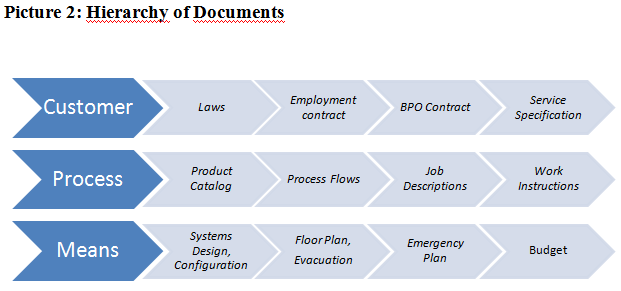
hierarchy-documents

(Originally posted on August 10, 2013 Pictures edited November 3, 2016)

Posted in Customer Service | 1 Comment

Shared Services for Dummies

(For non-Americans: “…for Dummies” is a popular series in which certain topics are explained very simply)

WHY SHARED SERVICES?

In today’s world every self-respecting multinational will consider Shared Services if only not to be left behind in the significant savings that are promised by this field. These savings are constituted by several cost reducing factors

1. Quality. Through centralization one can facilitate standardisation and uniformity. These are not always goals by themselves, but in the process of standardization it is discovered that the “unique” features required for a particular market often are nothing but a variation on a theme. When that insight is gained, standardisation will lead to simplicity, which in turn will lead to quality in execution. It is a long and arduous road, but it fundamentally leads to better and ‘cleaner’ processes.

2. Labor arbitrage. When the service is centralized, often a low-cost location is chosen. The initial and simple savings of labor arbitrage are evident but many overlook that there are 2 components to labor arbitrage: *first, there is the simple lower salary of a worker *second, when the processes are organized with Process Owners vs. Transaction Performers, one creates another salary differentiation between these 2 groups. The second savings is even more substantial when a different legal entity executes the transactions because the relatively high wages of the Process Owners do not infect those of the Transaction Performers as much. Often, next to a difference in direct wages, also secondary packages have significant savings potential.

3. Operational knowledge. Amazingly enough, HR Administrators – to take just one example and generalize away – have a pride in their profession, and they generally like to do their tasks well. Their main focus is on quality. Just as most Shared Services individuals are Transaction Performers who take pride in process efficiency. Regularly, 5% efficiency gains as very realistic. Recently I was told about a case where 10-15% efficiency gains were achieved within the first year, just because people were looking at the processes from a different angle. And yes, that operational knowledge is universal in the execution of HR, Finance or Customer Service processes. A ‘real’ operational manager from a Business Process Outsourcing or Customer Service organization will realize that the processes and skills at an ‘agent’ level are different depending upon the processes executed, but at a management level it remains a game of how many transactions did you execute at the right quality level. This is an expertise that requires experience to build up, and how many good process-experts can also manage a department?. (1 Horror story indicated a 90% loss of management during the switch from process knowledge-focus (which did not bring the performance) to operational management focus since these just could not fulfill the new requirements for the job.

  1. A final reason might be ‘oligopolistic anxiety’. All multinationals are watching one another to see where they can learn. Consultants are very keen on making comparisons – against a fee of course – in which corporations can compare themselves against others, direct product competitors or not. In effect they are all competitors in the capital markets. If the industry is creating cost advantages, one has to go along, if only to show stockholders that one does everything possible to maximize their holdings.

HOW?

One topic that is often a point of contention is the way the organization should be structured: who should have the operational responsibility (and thus power)? To explain how it works let me use the example of a car factory, which is greatly simplified in the drawing below. On the one hand, we have the “Process Owners”, who design the car, set the quality standards and verify that the cars produced adhere to their specifications. Next to the qualitative aspects, they also are masters of the quantitative aspects: how many Type 3, and how many of those in white with leather upholstery and a 1.8i engine do we expect to sell? This also drives the Purchasing Department, who need to make sure that there are then sufficient 1.8i engine parts to produce to demand. In the perfection of their work, the interaction with the customer has been improved so that these days many factories are only producing exactly to customer specifications. Still, corporate forecasting and the decision of which types are available – with the corresponding price tags – is done by the sales & marketing departments.

Figure 1: A typical car factory

 https://peteralderliesten.com/wp-content/uploads/2015/05/typical-factory2.xlsx

Now, given the demand for x black BMW 3’s with configuration y, the operation takes over and starts ensuring that these cars are becoming a reality, within the time period and the quality specifications drawn up. For this task generally totally different skills are required than for designing these cars. The interaction of these groups is a typical functional matrix-organization.

WHAT

When we examine Shared Services, we see virtually the same kind of pattern. Grossly simplified: from a management perspective there is little difference whether one ‘produces’ a physical car, answers a telephone call, or processes an invoice for payment. The differences are the kind of people required and the corresponding equipment. The expertise in how to use the equipment is centralized in the process descriptions and working instructions by the Functional Department and the job qualifications of the employees. Interestingly enough, this is also reflected in both technology and reporting: Most telephone switches are made for calling somebody outside. An Automatic Call Distributor (ACD) is a telephone switch made for accepting telephone calls, is is the workhorse of customer service departments. Such an ACD is programmed – and produces reports – from 2 different perspectives: the first perspective is from the customer: how many calls were received and how long did it take to answer them? How many customers hung up the phone before a connection was set up, and how long did they wait? How long did the conversations last behind the number for sales and how long for after sales? The second perspective is from the people that work there to answer those questions: how long were they working? How many calls did they answer and how long did their calls take? Hereby it is possible – and recommended – that agents answer phone calls from multiple lines, making this functional matrix organization the challenge for the Operations Manager. This description also applies to e-mail handling systems etc. The first perspective is defined by the Process Owners, the second perspective is determined by the Transaction Owners, within the specifications set by the Process Owners.

CONCLUSION

Therefore, if the operation needs to be regionally organized, the Process Owners and the Transaction Owners report into a regionally responsible function. If the operation needs to work according to global standards, the most logical organization structure would have the Process Owners report into a centralized, global standard setting function, while the Transaction Owners report into a separate operational function to take optimal benefit of relevant expertise.

(Originally posted on November 25, 2014)

Posted in Customer Service | Leave a comment

The Authority Trap.

One of the great sins of many organizations is that they have great expectations of their employees and give them a lot of responsibility, but do not provide them with the tools (‘authority’) to fulfill them.

The Trap

In the negotiation process between an employer and an employee, often the employer requires a lot of (Responsibility or workload of) an employee. The degree to which that employee is also been given the ”Power” or Authority does not always match this responsibility. Often that is perfectly fine, where somebody needs to organize something but still needs to get approval (e.g. for a budget) from a higher up. However, ‘doing’ certain tasks is virtually impossible without also having some appropriate authority. Once the difference between Responsibility and Authority becomes too large, the employee falls in the Authority Trap. That she then frequently has to be ‘put back in her cage’ because she oversteps her boundaries in her zeal to fulfill her responsibilities properly for the good of the company is nothing but inevitable. These ‘callbacks’ can be greatly demoralizing by themselves and are doubly harmful since they mainly occur to exactly the highly-motivated employee we will need again in the next difficult situation.

To avoid this pitfall and properly attribute employees, the following factors need to be aligned:

  1. Expectations

The very first item that comes to mind when hiring an employee is that she will fulfill a need, live up to certain expectations. To ensure satisfaction of both parties, one should ensure that these expectations are both made explicit and accepted by both. If an Account Manager comes to fulfill the role for 1-2 years on her way to the next career stop the Manager (or the Client for that matter) might not be too thrilled. At the same time, one can expect a little more from an employee that is very experienced than from a novice.

  1. Goals

Whereas expectations might be fairly global, goals should be SMART. These goals are also discussed annually and usually part of some kind of reward system (whether a bonus or not).

To ensure that the whole department works together on the departmental goals, often those are made part of the bonus structure of all of the departmental members.

How much departmental goals should constitute of the overall evaluation plan can be (sometimes hotly) debated, but 30-70% I have regularly seen, whereas I once saw a Personal Assistant given exactly the same goals as her manager, since she supported those goals directly via her boss.

  1. Responsibilities

Self-motivated employees do not need to be given responsibilities, they live them themselves. Sometimes even to the degree that it gives them physical or mental hardship, since responsibility often coincides with workload. Still, when the responsibilities match the capabilities of the individual, the next problem arises – all to often – if multiple parties claim certain responsibilities, or if (often external) parties are not aware of who is the ‘carrier of that responsibility’. Sometimes long arduous corporate processes take place discussing a RACI that is acceptable for all parties involved.

These responsibilities are not only crucial in distributing ‘responsibility’ but also in distributing information by establishing the communication lines. Whoever is responsible needs to be present when the topic is being discussed. A malicious mind would think that ‘Responsibility’ is sometimes claimed by employees out of pure curiosity. I once observed a ‘complete’ project team – which explicitly excluded communication lines as a topic from the agenda – that was meeting with one another during the whole week under ever changing meeting topics and constantly re-hashing the same information that a few externals had brought into this ‘information circus’. They considered the internal cooperation and communication as being ‘exemplary’.

  1. Authority

Whereas ‘Responsibility’ refers to ‘doing’,’Áuthority’ refers to deciding.(See also the IDA-cycle). In a way, one could see the Responsibility as the commitment the employee makes to the employer, and Authority the commitment the employer makes to the employee. When these 2 are not aligned, there is a continuous ‘overinvestment’ of the employee into her work.

Sometimes, the reason for not giving Authority is that it is very difficult to give somebody the (power of attorney/) authority, given the often legal requirements involved. That it is equally or more difficult to take away authority once given might be another consideration.

  1. Requirements

Before an individual is appointed to a specific position, she has to fulfill certain requirements, which might range from educational ones to experience to sheer intelligence. (Some American high tech companies have a reputation for the latter.) In today’s world ‘everybody’s’ background to fulfill requirements is publicized on LinkedIn. With the exceptions of the Germans and the Chinese who have their own versions.

Together with Expectations and Responsibilities this generally forms the basis of a job description, which forms the basis for the last item in this row:

  1. Remuneration

Often remuneration is not as much related to responsibility but to authority and requirements. To what degree neither of those have anything to do with remuneration but negotiating skills depends upon the individual company.

Posted in Leadership | Leave a comment

Sales generates revenue, Operations profits, and Politicians strategy.

“The only number surpassing the number of different personalities in the world is the number of different personality classification systems”. At the first glance, this sentence is a gross exaggeration. At a second glance, it still is an exaggeration, but maybe not so gross any more: one can classify personalities on all kinds of criteria: sexe, religion, ethnicity/cultural background, family structure etc. and every person has at least one system to comprehend her surroundings.

Is the world then really waiting for another Enneagram, Briggs-Myers, or whatever system to help understand our surroundings? For me, I look for simple explanations (“the simpler the truthfuller”), and I found the following helpful. You decide for yourself.

Scientists

Most professionals do their work for the content of it: one chooses to become fireman because of the inherent attraction of putting out fires. These jobs are focused on actually doing a particular activity: you use a fire blanket and not water because it extinguishes the fires instead of fuelling it. Activities are based on facts, rules or principles, and fixed, pre-determined working hours. These activities could be both product or services oriented. Examples are waiters, athletes, secretaries and researchers. With these functions we can generate products and/or a services proposal.

Operational managers

As soon as scientists need to cooperate or be managed, not only real facts drive decisions, but also interpersonal relationships: how does one constitute a team. Decisions are not solely based on facts any more, but on the interpretation of social factors, social skills are a prerequisite. Examples are: team leaders, project managers, operational managers. Now we have products that have been produced or services that have been rendered.

Sales managers

It is great to have designed (and produced) the world’s greatest mouse trap, but is the world really waiting for this? To clarify the benefits of these products and services to the customers we need the Account Managers of this world. In their job, principles and practicalities not always need to play a role: they produce promises, and facts play a subordinate role to interpersonal skills convincing the client to sign at the bottom. Now we have products that have been sold.

Politicians

Humanity has come to the realization that the three roles above are not sufficient. About the much maligned politicians it is said: “We do not really know what they do, but still they are indispensable.” Of all roles, they are the farthest away from principles, the most flexible, both in standpoint and in working hours. (In The Netherlands, the summum of political significance is apparently being included in the evening telephone calls after the Sunday 8 o’clock news.) The focus of operation here is “the process and nothing but the process”: do the right institutions approve to get to an agreement? Here also the trade-offs among topics are made and a perfectly good standpoint might be abandoned for a bigger and greater good. Difficulty often is that not all of these factors may be publicized, so one sometimes has to defend a particular decision with a ‘hand tied behind your back’.

In Summary:

Scientists Operations Sales Politics
Principle/flexible Pure principle 50-50 Mainly flexible Purely flexible
Fact/person orientation Fact 50-50 Mainly personal ‘Only’ personal
Working hours Fixed, limited Flexible, steady high Very Flexible, peaking Extremely flexible, work-dominated
Contribution Products and services Profit Sales Benefit to society, Return On Investment
Typical focus in industry Chemicals, raw materials Business Process Outsourcing Apparel, Retail Government, Multinationals
Typical Jobs Waiter, secretary, athlete, policeman, engineer, architect Teamleader, project manager, operations manager Account manager Mayor, Chairman of the Board, Lawyer

Conclusion

One could say: a scientist is responsible for products, an operations manager for profits, a sales manager for revenues, and a politician for strategy. Before you read further: what type of person are you?

Ultimately, every organization has a focus on one of these categories: e.g. a chemical firm on Science, a BPO firm on Operations, an apparel firm on Sales, and a municipal government on Politicians. Now it is the job of a Management Board to make sure that in her organization the right mix of all profiles is represented. Much wisdom in making your decisions!

(Originally posted January 22, 2015)

Posted in Leadership | Leave a comment