After a meeting, some people send a short summary to ensure all parties involved leave the table with the same understanding of what has been said. Traditional ‘meeting minutes’ generally are too formal, but an overview of action items in the IDA-ly (or DAI-ly) format often is useful.
In approximately 95% of the cases (in my life), the understanding was mutual, but in about 3% of the cases unclarities are being resolved immediately afterwards, thereby facilitating appropriate follow-up actions. With one or two partners, significantly higher up in the food chain than yours truly, I have encountered that reactions followed like “We did not discuss that at all” leading to utter perplexity on my side. Explanations like major errors or deliberately false statements on either side I consider to be only theoretical possibilities.
One more feasible explanation would be the following hypothesis: a person of high status – who is not used to significant push-back – has a tendency to become ‘intellectually lazy’ and might develop a habit that whatever he says will be accepted by the conversation partner. Especially in a tense situation when he makes a one-sided statement he might have a tendency to interpret that piece of ‘Information’ to be accepted by the other, so registers it as a mutual ‘Decision’ with consent. If the other party makes an ‘Information’ statement however, that piece might not register in his mind, so is not really ‘heard’ at all. This explanation seems impossible to verify without an over-the-top scientific experiment. For now it is the best explanation I have found, though, but I am open for better ones.
Somehow, some people are often asked to mediate in disputes among others. The author has been in such a position a couple of times but not enough to write a book on the subject. Still a quick checklist to avoid some common pitfalls I find helpful for myself – and maybe others would be interested as well.
What is mediation?
Mediation for me is a voluntary process of resolving disputes or, the art of helping two parties to agree sufficiently on a subject so that both may interact mutually advantageously in the future. That dispute might be on a difference in interests, but also a difference of truth/conviction/vision, or a difference of observations of the same objective facts. The main impediment to discuss their differences in interests generally are emotions that ran up so high they are blocking progress on the road forward. The mediation of these emotions often is the essence of ‘mediation’ as a whole.
The depth of the emotions often is reflected in the intensity of mediation required to reach results:
After separate discussions with a mediator, both parties resolve their issue amongst themselves
The presence of a mediator is required during the resolution, whereby the length of the process and the time invested provide an indication of the intensity.
Also with a mediator present resolution remains out of reach, and the mediators conclude they are unsuccessful. An escalation to another form of resolution might ensue (be it legal proceedings or in bigger conflicts even war etc.)
Which are the requirements for mediation to succeed?:
First of all, there needs to be a – preferably emotional – tie between the parties, some overarching interest that is the ‘why’ for mediation. Membership of a group of friends, employment in an institution or professional association for example.
Second, both parties need to accept a third party to intervene, so this third party needs to be acceptable to all parties involved. In practice, this means to have at least a reputation of integrity and impartiality.
Third, this third party needs to be both willing and professionally/personally equipped. How to determine this requirement is difficult, but please ensure all agree explicitly that this ‘proper equipment’ is so. And if any one involved party does not think that is the case, that is the case.
Fourth, there must be a possibility to have one-on-one conversations, to slowly ‘peel off’ the situation step by step without being sidelined by group complexities.
If the considerations above are not fulfilled, it is better not to think about mediation at all: let then the embroiled parties fight it out, do not get yourself entangled into a mission impossible. Sometimes the pain needs to increase before the patient accepts a medicine.
Then, the resulting process should take the following steps. Each of these steps can be framed in such a way that it facilitates progress to the next step towards a successful resolution of the differences, whereby an agreement to disagree could be a perfectly reasonable outcome. But preferable without the loaded emotions that would preclude future interactions, without the polarization.
Phase 1: Core Process steps
First, only the mainly and directly involved parties need to resolve their differences
Both quibbling parties need to express a willingness to resolve their differences. A professional code that they need to be open to or even be able to do so themselves creates a ‘need to act’ for them to maintain their group membership.
Then both need to accept the mediating party. An accepted mediator in the group greatly facilitates this step. If there are two mediators involved a chance of a ‘drama triangle’ from Transactional Analysis is greatly decreased.
By inquiring into the specific nature of the grievances, the mediator forces the quarrelers to consider the ‘marketability’ of their concerns, and a lot of ‘air’ that can build up due to non-communication is likely to evaporate. During non-communication emotions are ‘built-up’ to support the claim of pain, whereas the mere expectation of communication to the public generally brings back some more realism to the choice of words.
Often it makes sense to then ask parties to write down their timeline of observations, or the ‘facts’ they use for their judgements and emotions. Often, simple misunderstandings turn out to be the basis of much mischief. The downside is that this step is unusual, time-consuming and might not have much acceptance with emotionally tied participants. However, if one is not willing to explain one’s truth, then how interested is one in really resolving a conflict?
Crucial in this stage is that actual conversations are one-on-one to keep them pure. A grieved party should only talk about what happened to him or her personally. Replacement emotions “he did this to Ben, which is not acceptable to me” do not belong here (yet) but in Phase 2. It is remarkable how many people are emotionally upset about something that has happened to a third party who does not even think twice about it. (Or behind which ‘big back’ one can shield his own emotions.)
The consideration of a potential intervention of the mediating party in a way establishes that the parties are not capable of professional behavior. This ‘threat’ or in some cases ‘ loss of face’ facilitates a playing down of the effect so that ‘I am not difficult at all’. If the clarification of the outside view by the mediator allows to do so, a direct one-on-one resolution conversation allows face- and time-saving for all involved., although one runs the risk of the conflict not being resolved and the bushfire to continue unchecked.
Phase 2: Separate Bystander effects
Where John is insulted how Ben is being treated, John is only a bystander.
If one finds out that in the relationship between two parties a ‘bystander effect’ is involved, ideally first the matter is resolved with the directly involved party only. Give everybody the dignity to speak for themselves. And the emotion of the directly involved usually acts as a ceiling for the emotional involvement of bystanders.
In case a group is affected, the insulted/affected party should focus on what kind of effect the behavior has on her (regardless whether she is part of the group or not). Nobody but their elected officials should have the arrogance of speaking for a whole group.
Phase 3: Resolution: what is included and what not?
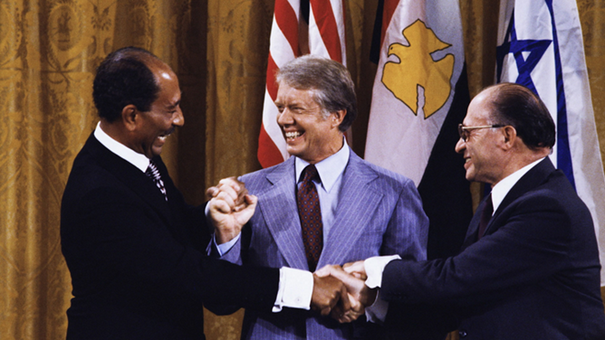
Crucial here for conflict closure is that both parties involved need to make a public gesture of resolution: like Begin and Sadat shaking hands under the watchful eyes of Carter sealing the Camp David Accords. In our lives the topics to mediate probably will be less impactful, but the process remains identical.
Elsewhere, I have made a distinction of all statements into Information (‘facts or observations’), Analysis/Decision (‘feelings and interpretations’) and resulting Actions. Only after the emotions of Phase 1 and 2 have been completed is it time to look at the consequences one can draw out of the situation. One can emotionally positively (or maybe neutrally) approach an individual but still do not consider her fit for a particular position. The mere fact that ‘two people have had a good heart-to-heart conversation’ does not mean they are best friends: we might be ok to play in the same team, but I do not want you as my roommate in the next soccer camp. We might even be best friends, but I still do not think you are fit for the chairperson position.
Conclusion
A simple checklist is nice, in practice situations usually are more complex. Add that also mediators are prone to make mistakes, and these kind of trajectories have a significant chance of running amok. Also, and especially, at the risk of the mediator. However, the bounty at the end of the horizon is removing emotional barriers that can eat up the happiness of people we consider dear. This author remains confident that the words above might add to the quality of mediation and wishes a lot of wisdom to all who venture on this path.
In my experience as a turn-around manager I learned that an effective intervention to turn around a bad situation had to be both swift and effective, like the biker on a rope needs both correct steering and sufficient speed to maintain balance (circus artists and cartoon figures excluded). One needed to take the right decisions at a high speed, if not, time would pass and with that trust (‘balance’), hope and success would fleet. More concrete, that would mean:
A vision that is enticing for all stakeholders (where do you bike to), which means that there must be a role for all participants. If there is no substantive role for somebody, he or she does not belong at the table. Then an intervention is needed to remove those that do not belong at the table. Also if that is painful. It is a real art, however, to make parties aware themselves whether they belong at the table or not. If that conclusion is correctly drawn, then also the stakeholder themselves have proven their professional proficiency. If a real stakeholder is – or feels – not represented, the setup is flawed. In such a setting each stakeholder will need to be given ‘his due’. If the value proposition does not allow for each stakeholder to be properly rewarded, apparently the value proposition is not good enough.
Velocity in decision making (sufficient speed). Time pressure requires the right pressure to the bicycle pedals, too little speed usually will lead to failure. Shifting might interfere with the cadence and lead to halting. Some rules that help and maintain velocity:
Equal valuation for similar roles. Several times I have seen great entrepreneurial ideas succumb to internal haggling about rewards. And in the end, what is more important: that you become a millionaire, or whether you are 7 or 14 times a millionaire? Same thing about salaries: nothing can trouble the waters more than one individual being able to negotiate for a better salary than another while adding the same value. In the ideal company (not possible in all cultures) everybody’s salary would be open to all colleagues – and they could be explained by management.
Fail fast: set milestones that need to be reached. If the milestone is not reached apparently you are pulling a dead horse. Then kill the project and just salvage what you can. But be prepared to draw up a new plan with a proposition taking advantage of the new landscape, if possible.
Fair pricing. No haggling about 0,9 or 1,1; the price is 1,0 and there is not sufficient time to ‘optimize’ pricing
Follow the proper process realizing the proper value creation (one fibre of the rope after the next)
First agree on the right value creation process/proposition to the market
Then agree on everybody’s overall role/position
Each role comes with specific responsibilities
Allocate sufficient resources/budget to each role
In case of commercial processes: describe Market dynamics, only then the P&L, Cashflow and Capitalization Table
Only at the end, one can attribute the proper rewards to the various responsibilities because only then there interrelationships can be assessed.
Credibility and earning trust (the safety harnass, or not)
There is no long term ethically successful business venture where somebody gets cheated out of his or her fair share.If everything needs to be ‘lawyered out’ it takes too long to survive to maintain velocity. Thus, if there is no trust there is no reason to engage in conversations.
If somebody betrays me, they loose their reputation so I will take the chance.
A contract is legally binding, a given word morally. Guess which one I find more compelling.
Therefore I generally try and confirm my understanding of the words given, this helps to eliminate misunderstandings and prevents the unnecessary undermining of mutual trust.
And then we circle back to ‘stakeholders’: one’s starting position, whether it is societal, job, reputation or stake(holder backing), they all can provide credibility. Which again is needed to get groups into movement, or: without proper support, how do you keep the rope steady?
Hopefully the above strikes a cord, and I would be interested in hearing additions or other opininos.
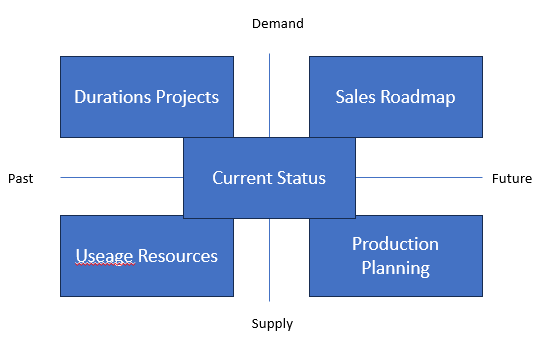
To steer any operational process, management needs at least five reports. Below a description of these five, which apply to it seems every industry (Please let me know if an industry has been overlooked!). The order is indicative of their importance, but do not be fooled: the lowest order reports (‘history’) are needed to verify the higher order reports (‘future’).
Current status
Of course, any business needs to have an indication of where the business stands. The KanBan Board showing which sales/products/services (‘demand’) are in which stage of development is probably one of the most popular reports. The expected benefit (‘Impact’/’value points’) of features is weighed against the cost (‘story points’/’T-shirt sizes’ /working hours’ ) and decisions are made on where to spend your valuable time. Little to add except that this report has very little predictive value by itself. For predicting the future, the following two Roadmaps are being used.
2. Sales Roadmap (based on calendar days, time)
The future of this demand is crucial for communication with clients and to drive the internal production. When does the next version of the game come out? Will we be able to present it at the next trade show, and when will the marketing materials need to be ready? What deadlines do we give to internal production?
3. Production Planning (based on working hours, effort)
A complementary report shows the planning of resources over the next periods (and on which features). Because somebody needs to do all the programing of those new releases. Here the first sanity checking can be done by verifying of the workload for the team really is realistic. Whether this planning is done in story points, T-shirt sizes or working hours does not matter, whichever measurement makes sense. (My private expectation is that ultimately you always end up in working hours, because these allow for comparison of workloads among jobs, can be planned and re-planned, can be used for verification of workload estimation afterwards – and usually will need to get paid.)
4. Product History (based on calendar days, time)
Now the commercial departments have a reputation of underestimating the time needed to fulfill their customers’ needs. (And overestimating the impact of these features on sales but that is a different chapter.) Now how realistic was the estimate of effort needed to produce the new release and how many times will the scope need to be extended?:
5. Resources History (based on working hours, effort)
And finally, the often overlooked basis of it all is an overview and resulting analysis based on the productivity of workers: what was the productivity of your individual(s/teams) on the various activities, how many hours were used to generate the effort needed? And how does reality differ from expectation, and what was the explanation for this difference? If last month we took x minutes per line item, what is the reason that we expect to spend 10% less the coming period?
Table 1. The four wind directions of operational reporting
Exchange currency
Impact or value points can be the measurement unit for demand, however, it would be advisable to translate them into market share or sales or something tangible to avoid ‘discussions of thin air’. The explanation is probably easiest when discussing the same mechanism for resources: one can translate story points or T-shirt sizes to working hours if the operation is internally. Any planning of internal people will ultimately boil down to number of working hours in a period, vacation and illnes time. (Similar for machines or land, with maintenance and repair.) In case one obtains external support where payments and plannings are made on the basis of other ‘exchange units’ – like e.g. story points – then formally it does not make sense. But believe me, you do want to keep track of a rough working hour indication of the people involved. The most frequent pitfall I encountered was some bean counter just calculating how many FTE would theoretically be needed, forgetting that an ever higher workload for a team will mean either a chance of burn-out (surprisingly, there is a limit to overtime) or an increase of the team with inexperienced/new programmers. Please keep in mind that not only will fresh inflow usually significantly decrease overall speed, but their training will use some of your best workers as well, making their candle burn on both ends.
Using the reports
The Current status plus both Roadmaps usually are used on a regular basis to decide on where to spend our resources and howe to communicate these expectations. Product History is the deep dive of Commerce whereas Resources History the same of Operations. However, a good general manager will once in a while conduct a ‘deep-dive’ into these reports. And that can be done fairly easily: you just take two consecutive reports and ask the differences explained. Then, depending upon the listening skills of the manager, in no time a picture of the status ‘below the surface’ and to what extent the operation is under control can become clear.
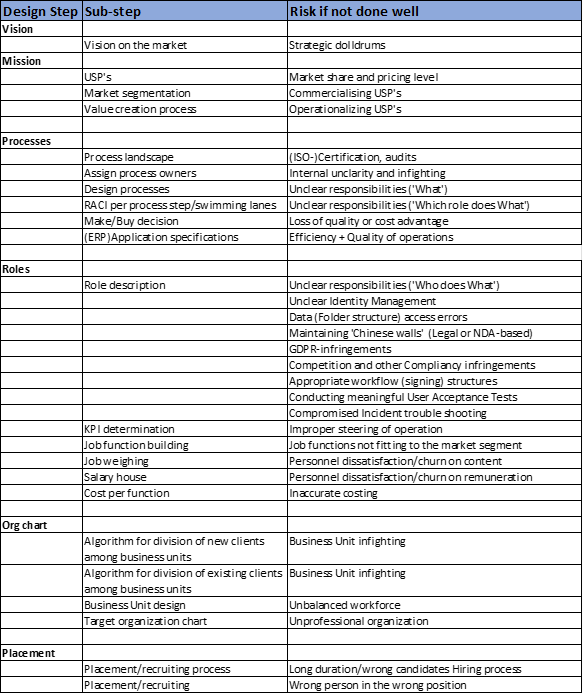
In a recent discussion with a couple of friends the question came up “What is the real consequence if the target organization design steps are not properly followed?”. After at first being taken aback it turned out that the question was (or at least seemed) sincere. Although most readers might consider the answer obvious, yours truly took it upon himself to identify these consequences in the table below.
An improper result of one (sub-)step has effects on the quality of the steps following. The culmination of course is in the role descriptions, which underpin many facilities and where multiple dire consequences have been listed. For simplicity’s sake the straightjacket effect of an ERP-system on roles and processes has been ignored.
Most organizational changes are implemented in two stages: first the target organization is designed, after which this concept is implemented. This blog will focus on the first step, where a typical design of this target organization follows the following logical steps (but not necessarily always in this chronological order):
Target Organization Design
Vision: how does the market look like? What are the market segments, size, competitors, other players? Which strategic trends are happening, what are the growth rates per segment?
Mission, or strategy design: how are we going to approach the market (either existing or new)? Which markets, which propositions, services, brands (and how do we segment the market amongst our divisions/business units etc. to avoid market confusion and provide focus?). What are their Unique Selling Points (USP’s)?
Processes: how are we going to provide our services and cooperate amongst ourselves? Which steps will we perform, which are automated, which outsourced and which do we keep in-house? How are we going to execute these staps, and with which (ERP-)system? Note: the importance and focus here usually lies on Order2Cash more than on Purchase2Pay.
Roles: which steps in these processes are going to be performed by which role with which function description? (thus: which salary and cost level?)
Organization chart: the size of the market over the divisions determines the division budget, the business unit manager then has to ‘buy’ various roles (similar to a ‘FIFA Manager’ assembling a virtual soccer team) and choose between ‘one Account Manager more’ or ‘an extra Operational Team Lead’.
The placement procedure: with any reorganization, the current worker population will need to be plotted into the new design. Where appropriate a decision will need to be made for lay-offs, in which case often binding legally prescribed procedures apply. If lay-offs do not play a role, still a documented and traceable process will need to be followed as objectively as possible in which employees will be assigned the roles they are entitled to. Only after that ‘mathematical process’ one is allowed to take into account the personal preferences of employees, since the advancement of one could lead to the disadvantage of the other. Of course, many employees affected will claim that they want to be heard beforehand, but it is almost impossible to do that without infringing upon the rights of others.
Potential pitfalls
The order in the development of these elements is logical and facilitates the easiest way to progress, however, it does not necessarily be fully chronological. Sometimes one needs to ‘cut corners’ in the interest of time or the lack of resources. Theoretically, one could even work ‘backwards’ and only pick up items when they are needed. However, every time one goes back one step and finds an error or improvement, it will have effects on a later step, meaning a choice to either accept an imperfection or force further changes down the line. Such an approach only works in a ‘sunny scenario’ where everything runs smoothly and no setbacks occur, so only ‘Powerpoint theory’ in my (mainly operational) experience. The inevitable challenge is to find the right balance between speed and care.
The completion of the target concept needs to be well before (possibly testing) and Go-Live. Some time before Go-Live the change project will enter a ‘Tunnel’, where changes occur so fast that one hardly has time to think. The only thing one can do is act. Changes to the ‘Target Organization’ can not be made without creating additional turmoil. All e-mails can not be answered any more, all telephone calls can not be returned. All the changes to be performed (and tested) need to be spelled out in the planning or chaos will ensue. The team will need to be able and rely on each other to perform their tasks in the playbook properly, often without the benefit of endless and frequent alignment, so trust is key. Decisions need to be taken on the spot, the unavoidable errors create ‘pain’, and so do right decisions. Any unforeseen factor may lead to delay, any delay will lead to additional costs in the term of either money, uncertainty or trust with employees. Before one enters a tunnel, one should know the road ahead.
‘The Tunnel’ does not always coincide with ‘Implementation’ or ‘Stabilization Period’ because it will start before Go-Live and needs to be complete well before one can claim Stabilization. The duration of ‘The Tunnel’ indicates how complex the change is and how well the change has been prepared, but for organizational changes often it is measured in months, not weeks.
Jumping the gun is another common pitfall: individuals positioned for new managerial roles might try and start to assemble their team around them to reduce their own and their new team’s anxiety, employees will seek out prospective allies among the new managers and try and seek to get confirmation about their new role. Both movements are counterproductive, since the placement process should be performed objectively, without endangering the position of those not involved in those private talks. When they come to light, a discussion might follow about morally reprehensibility, potential legal challenges and managerial maturity or as an opposite, managerial ‘slickness’ of those drawn into them or not.
Summary
When implementing an organizational change, first ensure the target organization has been designed completely, then re-check the implementation playbook for completeness and accuracy before jumping towards a Go-Live!
While Documentation might not be the most sexy topic with colourful relevant pictures, it is a fundamentally important topic. Recently I had a fairly heated discussion on the (how much) use of documentation, where the argumentation of “Trust me” was brought up to argue against documentation within a project. This difference ultimately led to the (temporarily) halting of the project, there are too many instances I have seen this lack of dedication/professionalism leading to failure down the line.
Reasons for Documentation
When talking about ‘Documentation’ I refer to the documentation of both informational items, decisions and actions, the latter both before (‘planning’) and after (‘report’) their execution. (See my previous post on how all text can be divided into these three categories.)
There are two main reasons why documentation is important. The first one is negative: ‘fear’, the need for traceability in a regulated environment. To ‘survive’ an audit – whether it be a business one like ISO 9001 or a governmental one like Anti-trust – the burden of proof has been reversed: there is no presumption of innocence, one has to prove that one has obeyed the rules. In case of non-compliance any penalties – amongst which one can rank a deviation in an ISO-matrix organization – become larger with the size of the organization. Hundreds of millions of Euro’s of governmental fines are no exception any more and some European governments have reportedly set up special task forces on such a business plan. No documentation means no proof.
The second reason for documentation is positive: ‘reliability’, the need for transparency to generate trust and or guarantee success: if we want to implement a change in an organization that change generates uncertainty for all involved, especially the employees. Transparency by means of a planning (who will do what when) provides certainty, as long as it is followed up later and reported how that planning – with all it’s last moment deviations – has been implemented. If documentation or communication is not required the change is an activity simple enough that one can perform it alone and not worthy of the title of ‘project’. For any real project one can say that no documentation means the project is ‘Out Of Control’.
Degree of documentation
We all hear about excessive documentation requirements: from thousands of employees per bank working on nothing but preventing money laundering, to care professional spending enormous amounts of time (although the time spent on overhead usually is badly documented) on registration of their actions, leaving them seven minutes to apply socks (and many professionals leaving the business because they want to “take care, not take notes”).
Below a couple of rules of thumb one can use:
If you meet, there must be a reason. If there is a reason to meet, you discuss meaningful things, if you structurally do not have anything to register, you probably have not discussed anything meaningful.
If you only register those items that are tested at a Quality Gate or ‘Go-Live decision’ you probably are ‘missing the point’, the activity is not a project but ‘running down a checklist’ .
Risks should always be inventoried ‘bottom up’ but extended by an overall ‘inventory’ based on lessons learned. A good Project Management Office has a suggestion available.
Risks should contain at least both content risks for the activity on hand, and generic project management risks.
10-20 risks for a small project (100k) are not uncommon, although many risks may be considered to be ‘low likelihood’.
Similarly, one can say about a meeting structure:
If there is no need for a structured meeting set-up, you probably have no need for a project.
The more professional the team (with an agenda sent out beforehand, and participants being on time, having read up on the topics, being involved in them, with professional expertise) the shorter time required per topic.
The biggest waste of time is every participant informing the others what they have done lately, justifying their own (professional) involvement. That kind of information can be shared independently, the F2F (or E2E) meeting is for interaction, to decide, analyze or agree on actions.
The more stable a team (both with respect to forming/storming/norming and to ‘political influences’) the less time required per topic.
Five minutes discussion for a topic seems minimum, unless it is just a ‘nodding through’
The higher up in the organization the highest-ranking official, the better prepared the topic needs to be. The (documentation) time required goes up logarithmically.
When introducing an organizational change it is easy to just focus on ‘the new org chart’ or new business. However, the success of implementing this change depends not only on the appropriateness of this structure but also the interests of those affected and – often overlooked – the perceived fairness of the process leading the implementation.
The appropriate ‘content’ needs to follow the right steps and in the right order. If this is not done, ‘procedural flaws’ prevent the change from success: if you don’t pay the application fee, a municipality will never even take your building permit into consideration; if you do not appoint a lawyer, most legal claims are not accepted in court. The original reasoning for these procedures were pure efficiency. A Steering Group/judge/Municipal Board can not learn a new format every time so insists on the same format to allow for speedy processing. That some procedures have ‘cancered’ into procedural nightmares is a different matter and will not be discussed here now.
The same ‘need for process adherence’ applies to organizational changes where employees will need to give their buy-in as well, not only formal employee representative bodies but also the general employee body at large. One needs to ensure to take the appropriate steps at three different levels.
Any discussion on a higher level is influenced by the one below: when talking about a new organizational chart, most people’s opinion will be heavily influenced by their expectation of their own position in that organization, just as any perceived (un)fairness in the process will influence the acceptance of people’s own positions in that org chart. Employees (or any other human beings) want to be treated with respect and fairness, if not, they will resist even the best change proposal.
In case of a typical reorganization with significant lay-offs the organizational chart is often designed in secret with the help of a management consultancy. Any acceptance of the results will be greatly determined by the strength of their arguments for the change (often adverse or changing market conditions). The next steps of placing individuals in the (remaining) positions can be done in multiple ways. In case of forced lay-offs, there generally is a national legal framework that describes which steps need to be taken and how positions are going to be distributed. This legal framework implies a certain fairness so a lot of resistance by subjected employees usually is reduced.
However, e.g. mergers based on market synergies are not based on negative factors and do not need to use legally prescribed methods. Still, one needs to design and communicate the process of both organizational design and attribution of positions beforehand to avoid discontent of employees afterwards.
A good design does not guarantee acceptance by all stakeholders, applying an acceptable process does not guarantee acceptance of the design, but overlooking the fairness of the implementation process does almost guarantee failure of both.
Many companies publish values. A real analysis or comparison of those can not be performed by just desk research and taking the words, but needs to look into shown actions, the translation of them into the real world. This blog is an effort to do so. Below is an effort to translate my employer’s values into more tangible – almost measurable – results for me. Not that I can always live up to them – see the last sentence below – but they are rules one may measure me against.
Result and future orientation
Time is time. 5 minutes late is a reason, 20 minutes late is apple pie.
On which date does ASAP fall this year?
If I would show my working space to my partner (or mother) I would be proud of it.
Responsibility and sustainability
Reputation comes first. A client is happy with our relationship, also after it ended.
I help a client to ensure that her customer is happy with their relationship, also after it ended.
The same applies to an employee of ‘my’ department.
Initiative and determination
Constructive criticism is an alternative.
Constructive criticism is a gift.
If someone gives me such a gift, I will feed back what I did with that gift.
Openness and trust
My manager hears all negative issues in/about my department from me first, nothing will be held back.
Unless a client or colleague can monitor herself, she hears all effects of my department on hers from me first.
My team hears everything that is appropriate for them from ‘upper management’ from me. In case they hear anything via the grapevine it is per definition not correct, complete or sure.
Fairness
When I have something (negative) to say about a person, I will communicate that to her first.
The reward for an employee is only based on performance and not on negotiation skills.
My evaluations I could explain to both the evaluated person and her colleagues.
Reliability, credibility and legality
Unless I indicate differently beforehand, my personal SLA is:
An e-mail longer than one screen or with an attachment will get a response within a week. .
An e-mail shorter than one screen will get a response the next working day.
A telephone call before noon will get a response that same working day.
To facilitate others in the above I will not send hasty/’superfluous cc’ communication.
I will not bcc to ‘cover my back’.
Diversity
If someone always agrees with me, she does not add value to my team.
If I notice (likely) injustice in the organization I will actively escalate, with appropriate energy and via the appropriate channels.
I make at least one mistake per day. Please help me to discover them.






 Peter Alderliesten's Blog