The need to combine Privacy with Transparency

INTRODUCTION

Most of us will agree that privacy of individuals by itself is good, and the maintenance of privacy should be the starting point, only to be denied if there are reasons for the greater good, usually having to do with the police and security. However, pure privacy among individuals without any transparency has it’s limitations.

Note: Below the focus will be on the relationships among individuals, so not on the relationship between individual citizens and governments.

PROBLEM

There are a multitude of situations where extreme privacy leads to unwanted effects. Below just a few examples:

  • High school kids can be approached by pedophiles who pretend to be much younger than they really are. On the one hand, one would want full transparency on the adult, whereas the child should definitely have it’s privacy protected so e.g. the pedophile does not know the child’s home address
  • In the connected marketplace all kinds of platforms allow individuals to exchange goods and money, from eBay and Amazon to Uber. These platforms have their own support structure to try and prevent scams and crimes, but how do I as a person know that I am safe being picked up by an Uber-cab? (The same applies to a Yellow Cab, but somehow that does not seem to appeal to reader’s fears as much.) According to Forrester, http://bit.ly/1RfokVm Facebook estimates 2% of it’s accounts are fake, Twitter 5%, whereas Linked can not say. That would mean that approx 31 million fake Facebook accounts exist, despite an active identification policy against them.
  • Not only our commercial, but also our private lives are moving into the internet. Most relationships in Western Europe are currently started via an electronic dating site according to some sources. In these ‘arena’s’ ultimate privacy also has some drawbacks: (mostly) female daters against aggressive (mostly) males; male daters against prostitutes/webcam girls/rip-off dating sites/automated&fake dating profiles; callgirls against aggressive customers; male grooms against fake foreign country brides, to name only a few obvious ones.

ANALYSIS

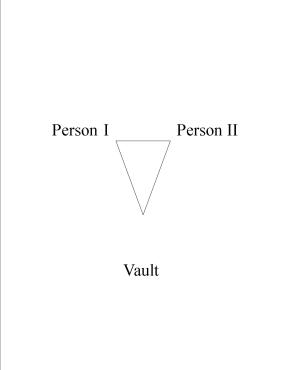
In all of the cases mentioned above, a balance between privacy and transparency needs to be found. A possible solution would be if there were a mechanism to link individuals with one another whereby a triangle is set up:

Publicatie3

In the relationship between the individuals, absolute privacy is maintained, whereas both individuals have a transparent relationship with The Vault. Individual I has disclosed her real identity (how far this should go with respect to name, address, bank account number etc. is a separate issue) and Individual II has done the same with his.

This set-up would provide 2 main services to both parties involved:

  • Person I can verify that Person II is a ‘real’ person to decide whether to even consider the interaction
  • In case the individuals engage in a social or economic interaction, notify The Vault of the ‘transaction’. In case anything goes wrong, the Vault will provide the information to the police.

Such a ‘Vault’ would require an organization with an infrastructure. After speaking to several parties ‘in the field’ it became clear that such an organization may not be a commercial one, since commercial considerations of that company might override the privacy requirements. At the same time, it also became clear that such an organization may not be a governmental institution, since political considerations might then lead to the same effect. Therefore, the vehicle for this organization should be a non-profit.

ACTION?

The words above are all nice and well, but they do not prove that there is an actual need for this non-profit with the working name “The Vault”. If anything  comes from this, first a larger “demand” needs to be established.

Posted in Transparency and privacy | Leave a comment

Sales and Operations

In many organizations both functions are like water and fire. Still, one without the other would die out quickly.


Archetypes

The archetype of a Sales Manager is the attractive, fast talking stockbroker who always sells the stocks, gets the high salaried position, and the girl at the end of the evening. The archetype of the Operations Manager is the grumpy, oil-covered mechanic who gets the car running, is underpaid and is the faithful husband and father. In movies they make great counterparts, in reality exchanges often are less witty. Sometimes, underlying contempt/inferiority-feelings combined with a basic distrust need to be overcome to lead the organization to successful cooperation between both blood types. `Somebody should make the promises of Sales reality!´ is usually just as true as `This can not be that difficult!´


Characteristics

SALES                                                OPERATIONS

Effectiveness                                     Efficiency

Emotions                                            Facts

Convince                                            Prove

Symptoms                                          Causes

Sales                                                   Profit

Urgent                                                Important

Customer                                           Product

Signature of contract                      Clauses of contract

Unfaithful                                          Boring


Yin and yang

Where everybody seems to be talking about yin and yang these days, this comparison of Sales and Operations fits in quite nicely. Every company has a predisposition towards one or the other archetype. Philips and Intel are famous examples of companies with a strong footing in engineering (and the Operations archetype), sometimes to the detriment of Sales. Some German engineering companies have a similar reputation. Most companies, however, have a propensity towards Sales. Not surprisingly since it is generally also the primary lifelihood of the organization. Still, just as typical engineering companies should nurture their Sales types, all of these other companies would be wise to make sure they have sufficient capacity in Organization, Operations, Engineering or whatever the business they are in, to ensure their long-term survival.

Posted in Leadership | Leave a comment

Acceptance Tests

Often I hear hard-working people – especially those that are really busy – claim that they have completed something, whereas the customer retorts that is not the case. See it like baking this wonderful cake (which indeed has been baked) but failing to bring it to the customer’s birthday party. The only way to guarantee that there is no mis-alignment is like every delivery service does: have the customer sign for acceptance. Below a way of organizing that this acceptance is organized in an ultimately simple manner whereby unnecessary surprises are avoided where possible.

When setting up a new service or facility the following acceptance tests are then required (the resemblance to the OSI-layers is purely coincidental of course):

  1. Facilities’ acceptance

Do we have enough square meters office space, workstations/desks, chairs etc.?

  1. Hardware acceptance

Same for computers, monitors, keyboards, mice, telephones, headsets per physical   workstation or laptop.

  1. Software acceptance

Can we get to the appropriate application log-in pages at each workstation? Any        communication links would also fall in this category: do we have access to this            application that is running on somebody else’s server? And are the latencies            acceptable?

An interesting one here is that certain additional applications might have to be   installed on certain workstations, where either a specialized team will work, or management tools need to be accessible for the management layer. (Or the one computer outside of the company network on a simple outside telephone line for exceptional uses)

  1. Configuration acceptance

Does every team member have a log-in to each application she needs and does that userid have the appropriate authorizations? Special point of emphasis is the additional authorizations that might be needed for the management layer. For practical purposes sometimes this test is divided into 2 phases, one for training, where general userid’s are used and individual userid’s when we go live.

  1. Application acceptance

Does the Application pass the User Acceptance Test for each use case? Or: have all use cases been identified and walked through successfully?

  1. Training acceptance

Did each employees pass their certification test before we let them ‘loose’ on our customers?


All of these acceptance tests can most easily be put in the form of a simple table, with vertically the workstations/employees/use cases that need to be tested and horizontally each hardware component or application. The resulting table can easily be turned into a Yes/No table (although userid’s are very handy next to user names). If there is a breakdown, users can identify easily where the breakdown shows, to help the arriving Facilities/IT/Training support troops to identify where they should focus their efforts.

Posted in project management | Leave a comment

Rightsourcing Customer Service

Introduction

Most industries know long term trends. The best-known example is Moore’s Law for the microprocessing industry. Today, I would like to examine some trends in the Business Process Outsourcing industry for Customer Service a little bit closer. Outsourcing here is evolving, where cost originally triggered it, a second wave followed where control became the main objective, whereas the advanced outsourcers are already moving one step further, with the focus on quality and the effect on the whole value added chain.

The cost drive

Initially, non-core activities of Western concerns were outsourced for mainly obvious financial reasons: large concerns with extensive secondary employee compensation packages tried to save costs by outsourcing these tasks to suppliers with significantly lower cost levels. Typically, services were outsourced to several suppliers who had to compete – sometimes even on a weekly basis – to get the business. The negotiating power of the purchasers was exploited here to the fullest.

An interesting example of the drive to cut secondary employment costs, and driving it to the top was the initiative from KPN in The Netherlands, which bought a large supplier of call centre services, and merged SNT with it’s in-house call centers in a (largely failed) try to get rid of its pension liabilities for the in-house call center staff.

After the simple national outsourcing, the lower costs of developing countries was utilized, and countries like India and The Philippines made great inroads in the Business Process Outsourcing industry. Ironically enough, it was the history of colonial exploitation that provided them with the competitive advantage to corner the BPO market: a large language speaking capability inheritance made the difference and enabled India and the Philippines to each develop a multi-billion dollar business.

The control drive

After these ‘quick wins’ were realized, it turned out that they might have been fairly ‘quick’, but not always a long term ‘win’. Increasing cost levels in developing countries sent manufacturing scurrying for new, unspoiled areas for manufacturing sites. Unspoiled here means still low cost. In addition, an ever increasing dynamism in the market required shorter lead times, where transportation times and cost from mainly Asia to the Western World became an ever increasing concern. I have once been in a position where a client of mine resisted moving the activity away from the city to the countryside because of the 2 hour ride to reach this new facility. Finally, it turned out that the management of a facility on the other side of the World is quite a different cup of tea from managing the same next door.

The reduction of the price advantage combined with the desire for increased control led for significant parts of the market to ‘near-shoring’. The fall of the Iron Curtain also made access to new supplier of cheap labor, and many sites were moved back to Europe again. So far, this is fairly common knowledge, but it sets the stage for the third trend that one now can see coming up in BPO.

The quality drive

Although control can not always be translated into bottomline directly, it paved the way for further insights: more and more concerns are realizing that cost is not everything. Everybody knows of companies in their own market that got into ‘rough weather’ because the Customer Service Department could not handle the orders for new products, resulting into backlogs for new customers, sometimes double work for installation engineers and – lo and behold – evaporating earnings.

In several industries the cost of Customer Service is only 2% of their sales price. However, when that process is messed up it endangers the whole value chain with a significant multiplier-effect. This notion makes several more sophisticated parties realize that cost cutting on this activity may look good for really short term ‘quick wins’, but it loses out on durability – and here I use the word without any environmental meaning: How much advertising spending is needed to overcome a customer service botch-up? Whether all investments in customer service always bring the returns of their Business Cases I sincerely doubt, but it has become clear to more and more parties that pinching every penny in this activity may be ‘pennywise but poundfoolish’.

Posted in Customer Service, Leadership | Leave a comment

A World of Full Transparency

Introduction

The other day I received a ´friend request´ for Facebook from a Real Life friend. Originally I mainly joined Facebook to do some research on social media but I always kept it low profile in an effort to keep some privacy: business contacts are traced via LinkedIn and I have no desire to show the whole world my not so flattering beach pictures. So I did not accept it. But does that make sense?

That question is part of a bigger one, namely what would happen if there were a world with full transparency? Earlier, I described integrity in https://peteralderliesten.com/2015/09/20/what-is-integrity/ and would full transparency not lead to full integrity? More specifically: what would happen if everybody in the world would carry a video recorder so that everything you hear and see, yes all actions, all words are recorded? What if all thoughts would be expressed as well by a next/generation device? Next to the recording, also useable search algorithms ensuring that the data is also accessible is part of such a world. What would be the meaning of in effect the end of privacy? Below an examination.

Where you are – transparency

The first part of transparency might be about one’s location, first of one´s belongings, second of oneself. Driving directions are a great feature, as is the location of my ipad in case I loose it. Some cars offer the feature of ‘Remote Services’ where your car can be found in this huge parking lot by honking it’s horn or flashing it’s lights. Stolen Vehicle Recovery is now a feature where these vehicles can be located for law enforcement, court order-based repossession of these vehicles was a logical next step. Multimillionaires already can have implants to trace their whereabouts, it is only a matter of time before this technology is available to also the lesser well-off.

A world of full transparency would mean that I would not be able to sneak out unnoticed to a motel with my mistress, burglar’s would have to explain their presence in any unauthorized home, fugitives would not be free any more, kidnaps virtually impossible, and lost children would always be found.

Still, there is a whole genre of movies about renegades fighting against an oppressing regime with overbearing strength from an underground – and secret – base. Apparently this possibility of evading a dictatorial central power appeals to a fundamental human desire/need. The possibility of government evasion by the powerless then would be given up.

Who you are – transparency

Another part of transparency is your demographic data. No more lying about age, no more glossing over any criminal records, no more driving around with expired driver´s licenses, or uninsured cars. Career swindlers will find it much more difficult to find gullible victims. Easy border passing , and getting rid of all those 5,000 different passwords, and finally room in your wallet for anything outside those membership cards. With all the new technologies from iris scans to Near Frequency Chips (NFC) this transparency is within the foreseeable future.

So far, these aspects seem fairly positive to me, but how about racial backgrounds that become immediately known: does everybody want that? Or the privacy of millionaires? Blackmail, kidnap etc. are all eradicated since actions and whereabouts are all known, but still, escaping your environment and living like a ‘normal’ mortal becomes impossible. The rich and famous will then be forced to also carry these unappealing consequences of their status. They will then still have the opportunity to give away their money, or stop joining ‘Dancing with the Stars’. (Although there are also people who are famous despite their own efforts.)

All salaries will be known, which might lead to an explosion in wages and might put several enterprises out of business, but would that not be just a temporary adjustment until everybody is used to this phenomenon?

Another thing is one’s DNA. Apparently studies have shown that 10% of all children is illegitimate. If the parents have made a ‘sidestep’ is it fair that the child is carrying that weight for the rest of her life? Also, there has already been a case where gay security officials were reported to select attractive male travelers for some ‘serious padding’; can then obviously-gay security officials still do their work? And there must be multiple other examples of negative or dubious effects of full transparency in demographic data.

What you said – transparency

Sometimes I wish I remembered what exactly I said, and how I said it. When going through an honest ‘Lessons Learned’ about a particular situation it would be so handy to just go back and review how something was said, how somebody felt at that time, and therefore what that choice of words and intonation did to the listener. It would be embarrassing to see one’s own words in full daylight, but also a possibility to review what really went on and thus what is needed to amend relations (or break them up properly).

In general, a public repository of everything that has been said in every situation would make deceit a good degree more difficult, no more backroom dealings, no more unknown side letters, no more hidden price fixing or deceit.

However, surprise party´s and other ´honest surprises´ would become more difficult as well. Would the world become boring? Or should there be a functionality that individuals can choose not to be informed about certain events? A kind of ‘opt-out’ of information, maybe even for a certain limited amount of time?

What you did and do – transparency

Traditional transparency would mean knowledge of all actions, paving the way for integrity between words and actions which can then be measured for each individual in the world. More and more public places are monitored by camera’s. These camera’s are used for all kinds of useful purposes like security, crowd control and border control. They have been enhanced with face recognition, identification an individual by his walk, object recognition so that a different color box highlights and differentiates moving animals from humans from cars. Walking patterns of crowds are identified to monitor their emotions and predict their movements. Some policemen already have all of their actions recorded, but there is no reason to believe that this would not be possible (or required) for all individuals.

The above already mentioned repeat swindler will have a tougher time to find victims because they know how he cheated on previous victims, habitual liars will be exposed, police investigations of accidents or felonies become superfluous, overly jealous spouses will find confirmation or denial of their fears, just for politicians nothing much will change.

Still, one defence for privacy is the question: “when was the last time you masturbated?” This reasoning is based on the existence of a taboo. In the course of time, taboos have dwindled, so they might very well disappear altogether. As soon as there are no more taboos, there would be no need for privacy. Also, it works the other way around: as soon as there is full transparency on actions, exposure to existing (innocent) taboos acted out will automatically lead to them becoming part of culture and acceptance of them. Taboos will become limited to those actions forbidden by the law.

Who you know – transparency

A further transparency would be who you know. Most of us already have accounts on Facebook, LinkedIn, Renren or Xing. Various other applications further detail the networks we have. With just a little bit of information on all of those that do not have their whole network documented, a relatively simple process of elimination and extension enables those with the necessary resources some pretty good guesstimate of the networks of all those missing links. This knowledge in turn can be used to identify the thoughts of person via the expressed thoughts of her social environment (or demographics). In a way this transparency supports a transparency between words and thoughts.

On the downside, one would be able to identify e.g. Falun Gong-members through association. I do not know whether the accusations of them being ‘farmed for body parts’ are correct, but it would make me very hesitant in forcing members of this group into publicity. More commonly known is that various religious groups have suffered under persecution under various dictatorial regimes and certain safety measures should be in place.

What you think – transparency

At this moment it is already known that through the measurement of electrical currents in a subject’s body, scientists can predict that subject’s decisions accurately before she herself is aware of them. From a business perspective this feature can help in identifying potential target groups: if one person in this group with these characteristics uses a product, the chances of selling the same product to the other group members are significantly higher. One could argue the ‘law of telemarketing’ here: to the degree the assumption about group buying effected by an individual is correct, the commercial offer will be successful and therefore repeated. If consumers buy it, then apparently a need is fulfilled, so the activity adds value to society as a whole; if consumers do not buy it, the activity will automatically disappear. Companies and governments will obtain incredible possibilities to plan the right roads, build the right houses on the right spots, and produce the right products at the right time at the right spot for the right price.

Wonderful. Great, so far. This transparency could ultimately lead to influencing, if not manipulation. And to what extent will there then still be free will? What happens if there is an error in this forecasting? What if the forecasting accuracy becomes so good and the volume of the resulting actions so large that this becomes a self-fulfilling prophecy? What if Big Data combines all thoughts with all actions and words making everything predictable? And what if an individual would want to step out of such a treadmill, would it become physically impossible? Does this mean the end of individualism? And what if this tremendous power would be abused by a central party?

Conclusion

Looking back at the situation of full transparency described above, it becomes obvious that it offers tremendous advantages for mankind. Of course, there will be all kinds of uncertainties involved with all these new developments. At the same token, full transparency will lead to such a concentration of power that the effect – if not the likelihood – of abuse of this power increases dramatically as well. Each of these transparencies needs to be protected by a certain freedom, and the total constellation needs to be protected by a certain Balance of Power to ensure no single party can take advantage of the incredible potential that is unleashed. Which would make some sense anyway, but that is a different chapter.

The table below is an overview of the transparencies and their associated freedom.

Table Transparancy/Freedom

Transparency of Associated Freedom
Where you are Freedom of travel
Who you are Freedom of discrimination
What you say Freedom of speech
What you do Freedom of oppression
Who you know Freedom of association
What you think Freedom of thought
Total Balance of Power

The degree to which we can take full advantage (in the sense of a value judgment) of transparency is determined by the degree of freedom in our society. Where the Western world is developing the technical prowess for ever-increasing transparency it also allows other societies to tag along – and in some cases jump ahead. Where transparency might add all these advantages to a free society, at the same time it is adding to the possibility to suppress in more dictatorial societies. Whereas the Western World develops it’s technical prowess, that also gives it the responsibility to ensure that technology is used wisely. Similarly, if technology firms will want to continue and develop their markets, they will need to overcome ever more resistance against the loss of privacy until freedom of oppression is guaranteed sufficiently in the societies they operate in. However, for now I think I can safely accept the friend request on Facebook.

Posted in Leadership | Leave a comment

What is Integrity?

Integrity is the quality of being honest, Wikipedia teaches us. Somehow I find that a difficult definition to work with, therefore I propose a slightly different one “Integrity is the degree to which objective Facts, personal Feelings, Beliefs/Ideas/Convictions, Words, Actions and Results of those Actions are synchronized.

Sensations and Feelings
Whereas Facts ‘should’ be seen identical by all, most frequently that is not the case. Whatever the actual occurrence, it needs to be translated into sensations for the human brain to process. Well-known are tests where e.g a yellow car crashed into a red one, where witnesses saw a blue car hit a white one (which experiment description by itself is also an example of ‘fact creep’). The ‘Chinese wall’-experiment where one whispers a message from one side of a row of people to the other, shows that often a totally different message develops throughout the process. That even leaves aside different preferences: a room temperature of 23 Celsius (about 73 Fahrenheit) might be ok for some, but for others way too high.

The art of realization of feelings is an area where humanity has practiced for centuries. Self reflection and meditation are only a few methods applied, to different degrees of success.

Belief
Logic dictates that beliefs and ideas are based on feelings and sensory input, often it is more feasible to identify feelings via the resulting beliefs or convictions. Here beliefs, convictions or ideas can all be used as a description for the whole of all of our sensory inputs processed by our mind. Especially trauma victims can be helped by all kinds of techniques to distinguish between original events (facts, whether real or imagined is of a secondary importance) and the (limiting) convictions that hamper personal happiness and development as a result. The degree to which a person’s beliefs and ideas are in sync with her own feelings is not only a measurement of personal integrity but also an indication of (lack of) impediments to personal well-being.

Words
The expression of beliefs occurs via words and other symbols. The art and science of persuasive speaking has been studied at least since the ancient Greeks but often has the connotation of insincerity. Still, rhetoric’s help in persuading others and thereby to transform ideas via those very words into actions of others. There is an interesting trade-off here, where integrity between beliefs and words vs. integrity between words and actions might have to be exchanged, a continuous challenge to many.
An additional challenge is offered by the development of ideas: where in time one might get an ever better understanding of the facts and thus ideas, it might be that therefore words in the past become outdated. The integrity among words in time might get lost, which generally is fairly easily documented so that a loss of integrity often is discussed in this arena.

Actions
Some of the most famous examples of recent times raising questions about the integrity are the ‘Guantanamo Bay’ promise of Barack Obama and the reneging on the rejection of the troika austerity measures by Alexis Tsipras. The discrepancy between words and actions was ‘obvious’ to many. There might be very good reasons why Obama did not close ‘Guantanamo’ – reasons he can not disclose because of legitimate national security interests, reasons he might also not have been aware of during his election promise – however, the discrepancy between his words and his action remains a fact. Similarly is the case of the Greek austerity measures: when taking a closer look, Tsipras apparently changed his mind. Whether that is for good reasons or not, the loss of integrity here is just as poignant.

Since these examples are supported by many more samples of broken election promises, one starts to doubt whether politicians as a group can be judged by their election rhetoric – and thus be voted on.

Results
When one undertakes actions with a particular goal, there is a certain expectation that these goals will be reached. In business these goals are generally fixed in the Business Planning and individual targets and bonus levels. In projects, the planning, scope and budget are similarly fixed. The degree to which one reaches the goals set determines the level of measured integrity, and the bonus paid out. These results are then the facts upon which a new integrity cycle will start.

Conclusion
One could focus on the consistency of only 2 elements mentioned in the overview above, but that would always provide only part of the picture. In the end, true integrity will be measured by the overall consistency of all of them, with each other, and over time.

Posted in Leadership | 2 Comments

Unnecessary rules limit freedom

Introduction

When I went to college I noticed a significant cultural difference between the US and The Netherlands: in The Netherlands one would study Law if flunked out on something else or did not know what to study at all (sorry to all erroneously insulted by this generalization), while in the US the best and the brightest would go to Law School. The explanation then was that Europe could rely more on a common culture, where the US relied more an additional laws. This emphasis on laws is also spreading to Europe: contracts in Europe used to be short, but these days they are ‘puffed up’ with all kinds of Attachments, Exhibits and Attachments to Attachments. This trend affects our society in several areas:

Law Enforcement

A friend of mine used to be an LAPD cop. He told me that he would focus on the tail lights over rear license plates, a common ‘irregularity’ which would allow him to stop most cars legally whenever he had another but illegitimate reason to do so. In effect, this use of the rules was nothing but a response to another rule, against harassment by police.

Another over-used rule is speeding: if governments really wanted to limit speeds, they would ensure cars would physically not be capable of driving faster than whatever the speed limit in that country allows. However, the collection of speeding tickets has turned into an underhanded and lucrative way of raising taxes.

Medical Insurance

One of the best examples of “Lawyer’s clogging” are the rules with respect to medical insurance when you are changing care insurers. It all starts with the ‘previous ailments’ which care insurers want to exclude from their insurance responsibilities. If person X is insured by company A and moves to company B which excludes the risk of an ailment that started while X was insured by company A, then company A should be held liable for that risk, logic teaches me. Just try and do that in real life. No wonder that people that are moving around for their work or for any other reason fall into this ‘uninsured trap’.

This challenge is only going to increase as more and more Europeans are going to travel across borders for more than 6 months and need to change their medical insurance as they do so. (Medical insurance is limited to a particular nation. That makes sense from an operational perspective, but it does hinder the free flow of people.)

Immigration

Even though immigration restrictions make sense, it does make significantly less sense to prohibit immigrants from working while they are awaiting the result of their asylum request. Especially since this might take up to several years. By not being allowed to work they are bored and – by definition – induced to enter the criminal circuit, while being prohibited from getting the best integration incentive of all: a job.

Companies

In this world of ever more (re-)integration of work and life, there are companies that absolutely forbid the use of company equipment for private use. Taken literally, that would forbid an employee to call the dentist for setting up an appointment. That the dentist is only open during office hours is only an inconvenient detail, of course.

Somehow, the rules of using private equipment for company use are much more lenient: if one uses the home Wifi to connect into the internet for the company laptop, nobody cares…

Another example is provided by software licensing agreements. Who is going to read 49 pages of legalistic text for an upgrade of a software package? A convenient solution by referring to an industry-set standard text would not make any sense at all, of course…

Same thing about music or movies: it has become so easy to download that copyright laws are hopelessly outdated and users are made criminals by the thousands, if not millions. Next thing is patent laws, where The Economist made an interesting case that current patent law in practice is also a protection for incumbents used to prevent innovation. All of these are arguments for legislation gone awry.

Conclusion

Any individual protesting against these stifling rules is usually powerless: companies or governments will not adjust their policies because of a single individual user who demonstrates it’s “ineffectiveness”, an immigrant rebelling against immigration laws risks being sent to jail (although usually at least in the country of destination) or maybe worse, having the entry request being turned down, and which car driver has never sped? In all of these cases, the power of balance has swayed too much to the lawyers. The rules have been made so one-sided and impossible to abide by, that ‘every’ citizen is almost automatically turned into a villain.

Summary

The US prides itself to be “The country of the Free”, but if one measures freedom not only in the taxes one has to pay but also in the absence of rules to obey, the ever growing clogging of “freedom arteries” by voluminous laws shows an ever decreasing freedom. The European Union is even worse: not only are rules to obey voluminous and increasing, it also becomes ever more unclear who is responsible for setting the rules. When even ‘professionals’ in governments do not even know whether responsibility for a topic lies with Brussels or with the national capital, how is a simple citizen supposed to know? Is that progress?


Posted in Uncategorized | Leave a comment

The kick-off agenda

A Dutch saying goes ´A good start is half the work´. This also applies in project management, where a bad start means double the work. In most projects a starting session has an agenda that covers all functional topics: HR, Facilities, IT, Design etc. That works well for smaller projects, but in my experience larger projects and programs need to provide control in a complex environment; then this functional approach shows quick gains in the obvious areas but does not ‘guarantee’ that nothing is forgotten. Then a different approach needs to be taken, even though opponents will initially see this as a waste of money and time since it hampers their ‘need for speed’. Like installing an airbag in your car: it costs time and money and is probably overkill if you drive the car on the premises to the garage, but most people would consider it useful when taking the highway.

The scope of this blog is the kick-off for a ‘big’project as defined in When to apply project management. For such a kick-off, I usually would suggest to take 3 days. For international projects, Monday to fly in and Friday to fly out would make a complete week.

DAY 1

Welcome

Generally it does make sense to start a session on the objective for why the participants have gathered. That objective is nothing but to come up with a plan of “Who does What When” at the end of the meeting. Minor detail is that often the Project Manager then needs some time to put it all in a presentable format, and maybe the project team then needs to go through an approval process after which an approved Project Plan has been established.

BASELINE

Introductions (Who)

For any group it makes sense to start with introductions of the various people in the room and the role they will be playing in the project. A natural continuation would be a description of the envisioned Project Team, the Steering Committee, Communication Lines and Escalation Paths. Note on the latter: I once was told proudly that a project had been completed without any escalations. I did not want to disturb the peace, but it reminded me of a quote “If you think you have everything under control in a project, you are not going fast enough”. So please do not skimp on this subject.

One nice way of ensuring support for the project is to involve a Sounding Board into the process. Depending upon their involvement they might either take part in the kick-off itself or join in for the “vetting of the Project Plan at the end.

Project Charter-Scope (What)

When we have clear who is who, the assignment or project Charter can be discussed. It is crucial to summarize the assumptions of higher management on this topic before starting, and to explicitly mention those items out of scope to verify whether that might be a big mistake in the view of some participants.

Project Charter-High Level Initial Planning (When)

A second set of assumptions of higher management, those with respect to time need to be made explicit as well. These milestones are not ‘set in stone’ but if there are deviations they need to be supported by facts/assessments/risks etc.

PROJECT

Work Breakdown Structure (What)

Now that the departure point has been made clear, it is time to focus on taking the scope of the project one level deeper. Per Functional area the major work packages are identified.

Again, also this WBS should have been prepared by the Project Manager so that at least the discussion can get a jump start. Otherwise you might easily loose 4 hours in settling issues like format and basic structure. This is also the point where Lessons Learned of previous projects can provide helpful input.

Sometimes I get the question to what level of detail a Work Breakdown Structure should go. My answer is that ideally this document should fit one (A3-)page. During the kick-off this is a good time to start identifying the various sublevel work packages (or the writing of the post-its).

DAY 2

RASIC (Who)

Now that we have an overview of what needs to be done we can settle on who will do the item. Essential are the Accountable (to sign) and the Responsible (to do), whereby I have seen different interpretations of whether the Accountable or the Responsible is the party to communicate. I do not necessarily have a preference, as long as it is clear. One often-used variant is that the Accountable person need to be in the project team – and thus is the center of communication on that topic, whereas various Responsibles outside might be steered by her.

Sometimes opponents to this ‘convoluted way of working’ comment that responsibilities are clear, because we all have our job descriptions, right? However the following example clearly shows the need to align: to establish a new service, a telecommunications link needs to be ordered by the supplier and installed into the server room of the client. Question 1: who is responsible for the access system to the server room? That the supplier should pay for it might be clear, but what if he wants to have a contractor drill a hole in the wall at the clients’server room? Question 2: is this preparation a Facilities-responsibility or an IT-responsibility?, especially relevant if client and supplier have defined that differently.

Planning (When)

Only now can we look at the timing of work packages: the responsible parties need to identify how long a particular step will take, and which items are required for them to start or complete that work package. Here the moving of the post-it’s takes place and input of various sides and sometimes heavy discussions are required to get to a common understanding of what happens when. In the discussion already a questioning attitude from each participant is crucial for success.

DAY 3

VETTING

Planning vetting (When)

For all those non-native English speakers: vetting is the process of background check. Candidates for a job – famous examples are presidents of the USA, but also candidates that need to be confirmed by Congress – have their backgrounds checked for scandals or other unsavory occurrences. This process might turn up so much dirt on a candidate that she is considered to be not fit for the role, or it might turn up publicity-sensitive topics that might need to be addressed pro-actively. A friend of mine was a gay high ranking government official. During his background check it was made sure that he could not be blackmailed on that subject.

After a good night’s sleep often the best ideas come up and the ideas from yesterday are reviewed in a more objective light. Here also a Sounding Board is definitely helpful, to identify the weak spots in the planning and ‘vet’ the plan on realism. Risks to the plan bubble up more or less automatically to feed the next agenda topic.

Risk Log (What)

One of the often overlooked topics is to identify the Risks to the project, not to be gloomy but to assess what countermeasure could be taken to clarify/quantify, mitigate (e.g. develop a fallback plan) or transfer (e.g. take an insurance policy) if not accepted.

Formally one also should look at opportunities at this point, if a competitor is closing down a facility nearby it might be possible to hire experienced employees very fast. Measures to exploit this opportunity are identified here then as well.

Open Points’ List(Who)

And finally it makes sense to identify who is going to undertake any individual actions that are not in the planning. The main distinction I make between planning and OPL is that Planning needs to be more formal and would be repeated in other similar projects, whereas an OPL is for one-time items.

Finally, if time permits, it also might make sense to share the period Status Report that will be produced, so that readers get acquainted with the format.

Posted in project management | Leave a comment

When to apply project management tools

Background

First of all, I would like to define the word ‘project’ to know what we are talking about. In job titles sometimes it is short for “We do not really know what to do with this person who is on his way out anyway”, some other times it means “We do not really know what she does, but by defining the job this way we do not need to spend much time on the subject” or embarrassingly “By defining the job as temporary we circumvent our salary-house and can pay the individual less”. It may be obvious that the usage of project management tools in these cases is either only superfluous bureaucracy or providing transparency in cases where it is not desired.

Below I will use the more common(?) usage of a project as “a clearly defined change, implemented in a particular time period, with a specified cost”. The alert reader will recognize the fundamentals for the devil’s triangle here: the continuous balancing between scope, time and budget.

‘On-the-side’-projects

‘All’ line managers have responsibility to maintain the regular operation but also make improvements. The act of implementing the improvement can be seen as a point on a to-do list or as a project. Resources for the latter generally are not formally assigned, the time horizon will be limited, budgets and the scope are generally limited to the realm of the responsible person. The person responsible for this change generally is the line manager herself and not a separate project manager.

One will notice that the previous paragraph is fairly unspecific, which is caused by the influence of the industry in which one operates. A budget of $10,000 might be large for a local retailer, but peanuts for an investment banker.

The minimum requirement for these kind of projects is (“imho”) an Open Points List.

Smaller projects

The time horizon for smaller projects is generally weeks to months for achieving changes that affect the target agreement of the sponsor and with costs within her realm. Since she is directly involved in the management of the project, no extensive paperwork is required.

The main components are relevant though: the assignment (“Project Brief”), a Work Breakdown Structure , a Project Planning and of course a Status Report. The person performing the project might appropriately be called a ‘project manager’.

When there is a recurrence of particular kinds of projects like the implementation of new clients, it generally is possible to develop a standard Work Breakdown Structure (to make sure all relevant topics are covered) and a standardized Project Planning (to make sure appropriate time periods for these work packages are attributed) . Not only are these helpful tools for the project manager to develop a project plan quickly, in addition it allows to work in a standardized manner and transparency to upper management.

Bigger projects

For projects with time spans of months to years, budgets where the sponsor needs to obtain backing at least one level higher and that also affect the targets of the level above her, one could argue that the sponsor is too low in the organization to properly fulfill her role. However, if one were to award sponsorship one level higher in the organization, that would often result in insufficient sponsor time and attention for the project, which makes the practice very well defensible in my view. For these kinds of projects though, the full range of all project components as I described in https://peteralderliesten.com/2015/04/21/a-project-plan-for-dummies/ needs to be deployed.

To properly take and document all steps in such a project, generally a supporting cast is provided by a Project Management Office. Whether the usage of such a PMO is necessary given the inherent costs (“bureaucracy”) always will be a topic of debate. The fundamental underlying issue is not just efficiency and speed of project documentation but the need for Control: if the project is not important enough to control in a standardized manner then yes all of project management methodologies are superfluous in that case.

Programs

One highly cynical (and therefore highly appreciated) colleague of mine once said that the only difference between a Program Manager and a Project Manager is the pay scale. To a certain degree that becomes ever more true, since in our highly automated world salary surveys link the two elements of pay and job title, after which HR Departments (also)

look at one’s job title to assess the appropriate pay and possibilities for a raise. Where job titles were just a subject of ego in the past, they more and more seem to have a financial impact as well.

Wikipedia is a little more specific: “Program management or programme management is the process of managing several related projects, often with the intention of improving an organization’s performance.” Therefore Programs affect the targets of the complete company and in general report to the Board. Given their importance, supporting cast is usually delivered by one of the big consultancies, time spans are typically measured in years, and costs are commensurate.

Posted in project management | 1 Comment

The proof of the expert is in the (De-)Modulation

(Like the proof of the pudding is in the eating)

Deep down at the core of the telecommunications infrastructure layers is an inobtrusive functionality without which communication could not take place (any communication). This same functionality also determines to what extent an expert is really good in her field.

Communication

When we speak, we transmit waves called sound. Sound (speaking, radio, telephony) consists of both a ‘carrier signal’ which provides the energy for transmission and a ‘modulation’ or a superimposed wave which tells the receiver what exactly is said, sung or played. Physics can go into great depths of this phenomenon.

The word ‘modem’ comes from Modulator-Demodulator, equipment that translates digital information into analog (so that it can be transmitted) and back again. These days, most people are not aware of the function of the modem anymore. In the beginning of the information age, one would attach a computer to the modem and hear it send out the signals. By listening to the sound you could determine whether it was working or not.

Expertise

“If you can’t explain it to a six year old, you don’t understand it yourself” Albert Einstein already said. And that is exactly the kind of simplicity that is also needed in regular business. For that purpose we need to translate analog expert experience into actionable digital information.

  • For a project we need to assess how likely it is that a leased line will be delivered in time by a telecoms provider. This delivery will drive when employees will be able to start using a functionality, so when they can be trained and when we can go live. The expert says something similar to:

“The telecom provider says that their normal delivery time is 4 months, but they will try for 3 months, this means that the chances are:

  •             3 months                     50%
  •             4 months                     70 %
  •             5 months                     95%”

With a recruiter we are assessing the likelihood of attracting employees to a particular facility. The expert says something similar to:

“One way commuting distances depend upon salaries:

  •             <$13/hr                      <20 minutes
  •             <$15                           <25 minutes
  •             <$18                           <30 minutes
  •             >$18                           <45 minutes”

These kind of assessments are exactly the kind of information upper management needs, six-year old’s language. The reason for this is – again – simple: it is not dependent upon field of expertise so can easily be compared with risks in other areas, and it is quantified, allowing for a simple Impact times Chance calculation so that decisions can be supported by a decision document.

If you accept this, it becomes very easy to spot the real experts: by their capability to translate all that analog information of their field into a digital estimation and back. Or: can they (De-)Modulate?

Posted in Leadership | Leave a comment