Organizational Projects and co-dependencies

In the past I have written about meetings, where Information is being brought into the session, on which basis Decisions are being taken, and Actions agreed. Everything that happens professionally in that meeting can be categorized as such.

The same basis is also reflected in organizations: a Project Manager is responsible for the process, so to ensure that transparency is created, information about the status of the project is shared. On that basis, the Review Committee can make decisions, which Project Team resources need to do.


Levels of abstraction

Similar to the structure of information in meetings, if in an organizational project administrative tasks like process descriptions  need to be written, a process manager usually will write the process description, the process owner would have to approve it. For IT applications exactly the same applies, just the roles are named slightly differently: Application Owner and Application Manager.

To keep a clear distinction about what the tasks are of each individual parties it might make sense to distinguish between ‘Levels’ of abstraction: Level0 is the party actually doing the work (the ‘Resource’), Level1 is taking the decisions (the ‘Owner’) and the Project Manager who reports the status the Level2. As long as the Level0 remains the person actually doing the work and the reporting becomes ever more ‘distinct’ from the actual doing, Levels 3 and higher might be added to reflect the various delegation levels. The highest number is reserved for the Product Owner, let’s call him L4 who specifies the Project Requirements.

These levels have a second usage as well: during the change the expert Product Owner generally is overburdened – which is the reason the Project is set up. This workload means that the Product Owner can not answer all of the questions that come out of the organization. By channeling the questions from the L0 in doing the work via the L2’s to the Expert L4, also a multiplier effect is being achieved. Simple questions can be answered immediately and only the difficult questions reach the Product Owner.

Coincidentlally, this structure partially overlaps with the RASIC-distinction: The L0 doing is  ‘Responsible’, the L1-deciding is ‘Approving/Authorizing’, the L2 needs to be Informed, the ‘Supporting’ is nothing but a differentiation of the L0-doing and the Consulting’ is nothing but the L4-Expert.

Co-dependencies

For such an organizational Project often a Staff department is the ‘Client’ or Product Owner (‘L4’). An easy pitfall for this Product Owner is that he usually is so overburdened with work coming out of the change that he does not have time for clearly specifying what exactly needs to be done, let alone writing a clear acceptance test. In practice I have noticed two prevalent ‘cop-out’-strategies. First of all, the absence of an acceptance test gives him an easy way to torpedo any project result: with no justification needed the result can be declared to be ‘substandard’. The Project never gets finished, so a good Project Manager will not allow this to happen. The second ‘cop-out’strategy is to just accept the project result and not create waves. Thus, Line Management just continues as it has done before. After completion of the Project, the Staff department can continue easily finding errors and complain about the Line. Here a co-dependency exists between the Client(‘L4’) and Project Manager which can only be tackled by general management one level higher demanding a rigorously executed acceptance test. A professional Product Owner provides a clear specification and acceptance test, but not every Project Manager is so lucky.

In case Line Management is too busy doing their regular work to take upon itself to do the additional work a Project always entails, the Project Team might be ‘forced to do the work themselves’, for which they generally lack the expertise and which results in the Line Managers not getting the additional knowledge and experience to continue the change. Here a third conspiracy-like co-dependency may develop between Line Management and Project Management: if Line Management accepts the quality of the work done by the Project Team, the Project Team meets its goals and can declare victory. Top management gets Status Reports in the green and is off everybody’s back. As of the moment the Project Team is disbanded the knowledge about the change dissipates and everything reverts back to the original state. A sure-fire way to failure in the long term.

The reader will be relieved that of course this self-defeating cycle does not occur in her own organization.

Posted in project management | Leave a comment

Professional Allergies

Fortunately, the distribution of Outlook to all of our laptops has been followed by an incredible increase in professional handling of interpersonal communication with respect to meetings. Therefore, we can now declare an end to “The Middle Ages of Communication” in which the following allergy enhancing strategies were employed to bother us all:

Invitations to meetings
• Send a mail to meet at a particular date and time instead of an invitation. (Which mail in the best of cases would at least contain that information.)
• Send an invitation without checking whether I am available at that time according to my electronic calendar.
• In Germany it is customary to go and have a(n of course planned) lunch with your colleagues. Only the shy maintained their own agenda with just plain ‘busy blockers’ for lunch, so that nobody would invite them for that social occasion. A repeating appointment put on ‘tentative’ would just be cluttering the agenda, of course.
• Not maintaining one’s own Outlook calendar so that when someone sent out an invite for a free space the response came: “Sorry, I am blocked at that time”.
• Or even worse, an e-mail instead of an Outlook-proposal “Sorry, I am blocked at that time, would the next day work?”
• Or even topping that: “Sorry, I am blocked at that time, could we do it later?” The absence of any substantive response kept you from inviting that person again, ever.
• To think about even sending a response to an invite was outrageous, of course, people would decide on the day itself which of their invitations was the most pressing.
• During our holidays, we did not yet have an automatic cancellation of our invitations during that timeframe, so that a group wass waiting for a person who just happened to have taken off that day.
• Out Of Office was not shared with colleagues, either through either access to the agenda or by sending out an invite to them (non-blocking, no response required of course)
• A way of pretending you are busy was blocking your agenda – and for good measure put in an Out Of Office-message – when you were working from another site of the same company. Access to e-mail generally was not guaranteed there, of course.
• When adding a participant to a large meeting, not just forwarded the meeting to the new participant but also distributing the update to all existing ones.
• Not proposing an agenda for the meeting at sll.
• Or going overboard: not only proposing a list of topics to discuss for the meeting but also updating all participants on the whole discussion about putting the agenda together.

System enhancements
• When organizing a recurring meeting with multiple participants sometimes Outlook took over the creation of obnoxious errors: I once had a colleague who updated the time of a meeting once, but Outlook took care of it to repeat the same message to all 85 participants four times. (No, not a lame excuse, verified error.)
• While we are at system errors: Skype had the habit of not adding a Skype link to an invite for addressees if the invitor happens to be offline himself, for instance if he had just changed his position after coming from a meeting room. To facilitate greater confusion, the Skype invite did show up in the invitor’s own agenda.
• When making a mistake like above, no colleague informed us about it.

Meeting minutes
• No meeting minutes were kept at all, to facilitate confusion later on about what was agreed upon. A secretary to minute the Board meeting, of course, is way too expensive.
• Meeting minutes that were unclear and not identifying among ‘Information shared’, ‘Decisions taken’ and ‘Actions agreed’.
• Action items were not understandable out of context
• No confirmation that the meeting minutes had been agreed would be exchanged (“That is how you might have written it down, but that is not what I said three months ago”)
• No storage methodology for the meeting minutes was available. Nowadays it could be in mails, a folder, Sharepoint or anything else, as long as participants can find it back.
• Meeting minutes consisted of only the slides shown, which was very helpful to document the discussion they triggered.

Behavior in meetings
• My absolute favorite: “We will do this ASAP (As Soon As Possible”). For those of you not in the know, ASAP is a public holiday on the first Sunday in September. Every year I organize a barbeque in my (non-existent) rooftop garden for those who have used that word that year in my presence.
• “We will do it later”. Apparently the task was not taken seriously enough to plan it with a date. The worldwide implemented remedy is to ask the question “When?”
• “We will have to re-visit this”. Even more abstruse (=unclear) language to say the same as “We will do it later”. Same remedy has been implemented.
• “I need more information”. Apparently the authors of these words were just trying to get away from the task since they did not even specify what information they needed to do it.
• “I do not know the answer” or “I can not”. The questioner was not taken seriously but just ‘brushed off’. Here the remedy of “Please specify what you would need to provide the answer or do it” has now been universally implemented.
• Some colleagues liked to hear themselves talk. Their counterparts apparently had insignificant contributions and did not matter. Usually this pattern was evidenced by people preventing questions by increasing their pitch and volume to ‘outvoice’ their ‘subjects’. Unfortunately, Outlook does not have a solution for that yet.
• Finally, items were analyzed “in order of urgency”: First the actions were agreed, then the decisions to justify the actions, and finally the information was shared to justify the decisions. Of course, this very productive way of working is to be continued.

In short, thanks to technological progress we now have also improved how we interact with one another. One step has been made on the road to universal happiness.

Posted in Leadership | Leave a comment

Universal Business Process KPI´s

Universal business process diagram

It has been a while since I wrote on this model, and it has been enhanced only so slightly during time. Below we will discuss the KPI’s that are necessary to measure the performance of these (sub)processes.

Diagram 1. Universal Business Process Diagram

bpo

Note: Support = Finance, (Fundamental)Research, Quality, Legal, IT etc.
Note: Processes = standards, guidelines, innovations, laws
Note: General Management is the third dimension overseeing it all
It is remarkable how much one can read from an organization`s Process Landscape. In some example´s I have seen, General Management was shown together with HR and Finance ´on top´ of the core process, and all other supporting processing ´below´.  To what extent that reflects the perceived importance of HR and Finance in these organizations is interesting to examine. In the model above, the Core Process is leading, all other processes are supplying-supporting, and only ´general management´one should see as in the third dimension, perpendicular to the page, integrating them all.

CORE PROCESS KPI’S

Whereas Customer Processes and Client-Distributor Processes generally are fairly industry-specific, from Marketing onwards the BPO/processes are fairly similar regardless of the underlying industry. The same can be said about the KPI´s belonging to those processes. Some may say that the KPI’s below are ‘self-evident’ but some heated discussions have proven that not all companies see things identically on this topic. Below will not follow an argumentation why each individual KPI should be taken, instead when one sees the process-‘building’, however, the logic of the identified KPI’s becomes clear to most.

The development of KPI’s starts fairly counter-intuitive: the last party in the process indicates against which criteria it can accept input from the previous process. In a way these are the ‘reverse Service Specifications’ or ‘Lastenheft’ or User Acceptance Criteria. For instance, for a car the ultimate consumer defines the model he wants to buy. ’Assembly’ then specifies how large the tires need to be to fit under it and which grip they must give to the moving vehicle. The tire department then specifies which pattern in which rubber in which diameter the tyre needs to be made off in order to fulfill the grip-criteria, etc. Once those acceptance criteria have been set, production can start and rubber can be delivered. All of these specifications are then documented for the beginning of the process, and added into the contract to ensure that the client at the end will purchase the agreed upon product. To measure the fulfillment of these acceptance criteria, we use the KPI’s. At least in theory, in practice a lot of adjustments and tinkering takes place.

In a similar way, Operations for BPO indicates it needs x in revenues to generate the desired EBIT, sales indicates that it needs y opportunities of a particular size since it will close z% of them, so Marketing needs to identify a market that is again n times larger. And then, after a while these criteria are adjusted based on the Lessons Learned, of course.

The Core Process KPI’s would then come to:

Marketing (Research)

  • Number of ‘Market Opportunities’ >x EUR according to the criteria of Product/Service Development
  • Number of RFI´s > x EUR existing, according to the criteria of (Pre-)Sales

Product Development

  • Number of Solutions for x EUR in Market Opportunities identified by Marketing

Sales

  • RFQ/RFI %(or: in how many of the identified cases are we invited to bid? The KPI for Public Relations or Pre-Sales)
  • Contracts/RFQ (or ‘hit rate’) or Revenue in absolute EUR
  • Deviation of Contract Profitability (EBIT or in BPO ‘OM3’) compared to Planned EBIT. (In Business Process Outsourcing (BPO), generally  ‘OM3’ is used instead of EBIT, where the account-specific costs are subtracted from revenue to isolate overhead costs which Sales and Service Delivery can not influence anyway.)

Implementation

  • Client (so ‘Contracting Party’) Satisfaction about Implementation, or Upselling Revenue Without RFP
  • Deviation of Actual EBIT (/OM3) compared to Contract EBIT (/OM3)

Service Delivery (Account Management)

  • Client (so ‘Contracting Party’) Satisfaction, or Upselling Revenue Without RFP
  • Deviation of Actual EBIT (/OM3)compared to Contract EBIT (/OM3)


SUPPLY FUNCTIONS

The Supply Functions KPI’s generally are fairly stable, but their importance varies by industry:

Human Resources

  • Speed of filling vacancies
  • Quality of candidates as measured e,g, in tenure with company after hiring
  • Salary level compared to market

Purchasing

  • Cost of Materials
  • Responsiveness of Purchasing

Production

  • Customer (so ‘End User’) Satisfaction
  • Cost of Production (typically ‘OM1’ in BPO) compared to Standardized Production Cost


SUPPORT AND GENERAL FUNCTIONS

The Support Functions in an industry may vary greatly, below just a few examples, with no pretention or intention of being complete at all:

Finance

  • Accuracy and timeliness of reports

IT

  • Cost per seat or product
  • Speed of Change Request implementation
  • Uninterruptability of IT Services

General (‘Integral’) Management

  • Actual Revenue vs. Target
  • Actual EBIT vs. Target


When a company uses these KPI’s, they will be interrelated, and the efforts of one department will be focused on facilitating the next. No, it is no guarantee of success, but at least one will have a picture of how one can have success in the business and what each department is contributing to it.


Legend

  • RFI = Request For Information = Client considers purchasing and scans the market for information
  • RFQ = Request For Quotation = Client wants selected providers to provide an offer
  • OM1 = Operations Margin1 = Revenue minus variable costs for the product
  • OM3 = Operations Margin3 = Revenue minus attributable fixed costs for the product
  • EBIT = Earnings Before Interest and Taxes, or profit


Posted in BPO, Leadership | Leave a comment

Simple Professionalism

Especially when dealing in an intercultural environment many different ways of dealing with this (until now by most considered to be necessary) ‘evil of physical or teleconferencing meetings’ can be found. In one project we developed a way of working that I still consider to be ‘best practice’ and which agreements I would like to share with you.

There are extremely funny Youtube video´s sharing the ´Don´t´s Observations, below also the suggested ´Do´s Alternatives. These rules I hold for self-evident:


Setting up one`s own generic agenda

Observation1      No entry of all meetings in agenda                                                           Alternative1        If agenda shows empty space and the subject is ‘appropriate’, acceptance is guaranteed

Observation2     A repetitive blocker for e.g. lunch with yet unspecified partners is set on `busy’                                                                                                                                  Alternative2        Such a repetitive blocker is set on ´tentative´. A repetitive blocker for doing work that can be moved is also set on ´tentative’  indicating the slot may be used if   alternatives the same day remain in my  agenda. Acceptance not guaranteed.

Observation3      Blockers have various starting times                                                Alternative3        In principle, one-hour meetings start the  on the whole hour only, to maximize the number of slots in a day

Observation4     Colleagues have no reading rights to my agenda                                             Alternative4       Depending upon sensitivities, reading rights an agenda to agenda is spread as broadly as  possible.  Just don’t put sensitive details in an invitation title but in the text

Observation5     Immediate colleagues do not know where I am                           Alternative5       Immediate colleagues either have a ‘non-blocking absence notice’ in their  agenda or can read it in my agenda


Organizing a meeting

Observation11      Repetitive meetings planned individually                                       Alternative11        Repetitive meetings planned 3 months in advance. On standard times and days of  the week

Observation12      60-minute meetings planned back-to-back all day long         Alternative12         50-minute meetings leave 10 minutes for closing and checking for urgent messages

Observation13      Working without agenda                                                                Alternative13        Best practice: sending an agenda 1 week  in advance . Good practice: sending an agenda a day in  advance

Observation14     Agenda with only content                                                               Alternative14       Start with (Welcome and) ‘Setting the agenda’ , .end with ‘Miscellaneous’. Declined invitees receive agenda in cc

Observation15     Always hold meeting                                                                              Alternative15       Always plan the meeting, but if not sufficient content, cancel it


Responding to a meeting request

Observation21        No response at all (From either of 2  Schools ´If I did not respond, I will not attend´ or ´If I did not respond, I will attend´)                                         Alternative21           Decline or confirm

Observation22       Confirm or decline via general mail                                                Alternative22         Confirm or decline via invite response

Observation23      `This time does not suit me, could we do it later?                     Alternative23          Suggest time proposal

Observation24      ´This time does not suit me, does … fit?´                                      Alternative24        ´This time does not suit me. I see in your´ Schedule Assistant that … would be open, so I sent this proposal. Would that fit?

Observation25       Always participate because it shows you are important                              Alternative25         Only participate if added value is clear


Chairing a meeting

Observation31     Incomplete group at 5 minutes, keep on waiting until complete                 Alternative 31      Start or cancel after 5 minutes

Observation32    No agenda                                                                                          Alternative32      Best practice: send an agenda 1 week in advance. Good practice: send an agenda 1 day in advance

Observation33    No meeting minutes                                                                        Alternative33      Best practice: meeting minutes draft later that day. Good practice: meeting minutes in 1 week. Absent regular participants sent minutes in cc

Observation34    Just continue when meeting goes beyond planned end          Alternative34       Stop 5 minutes before planned end, explicitly discuss continuation or closure, in case of continuation allow for those who have to leave to do so gracefully


Participating in a meeting

Observation41       No notification if late                                                                              Alternative41         When expecting more than 5 minutes late  Whatsapp or Skype notification to chairperson. Best practice when more than 20 minutes late, pays for coffee for all who have ´waited´

Observation42    Being called and answering (walking out of the meeting is no excuse)                                                                                                                                   Alternative42      Best practice:  on airplane mode. Best practice in case of important call± announcing at the start of the meeting, declining to answer other calls and send them a prefab message instead. Good practice in case forgotten to turn the cell phone off: let it ring. Medium practice: taking the call and verbally indicating that unavailable

Observation43     When joining after ‘Welcome and Setting Agenda’, new round of greetings                                                                                                                                 Alternative43       Partial participation will occur without separate  welcoming or departing greetings since  these generally are too disruptive. Early departure should be announced at the ‘Setting agenda’

Observation44     ‘Breathers’, car noise, wailing sirens etc                                         Alternative44      Put yourself on ‘mute’ when not speaking. That also provides the chairperson an overview of  who would like to say something. (Explicit requests to be allowed and say something usually is too formal to work smoothly.)


One final comment: these are Best Practices, that does not mean that we are (or I am)  always in a position to live up to them…


Posted in Leadership | Leave a comment

The horizontal Peter Principle


Most of the readers of this blog will be familiar with the ´Peter-principle´, below I will argue that this principle is not only limited to the ´vertical incompetency´ but also has a ´horizontal´ equivalent.


The hierarchy

But first a little discourse into the background of career making in larger corporations. To understand the management layers of a large corporate, one can divide employees into several layers.

The real work is done by the general workers. Protected by unions, central labor contracts and the like they provide the basic production or service work, constituting the core of the organization. These employees are steered by the ´lower management echelon´, the foremen and teamleaders that by themselves are again the backbone of any organization. As such they were already seen by Napoleon, who recognized the importance of the sergeants in his armies. This group of employees generally also is covered by the central labor agreements.

One step higher in the hierarchy we find the lower middle management: operational management, but also staff members like lawyers, accountants etc. Usually they are not covered by the central labor agreements any more, do not have to ´clock´ their time because of ´work sovereignty´, which in practice means that their overtime is not getting paid. That may sound unfair but it is the only way to practically get the job done:  if a Sales Person travels 50% of her time internationally, how are you ever going to get that properly registered and paid? Most people I know in such positions also accept this phenomenon as unavoidable and just belonging to the job.

Those ´lucky´ enough to make the next step up from middle management are getting into the layer of ´higher management´. Here we get into the formal decision-making structure, these are the people that formally need to sign off on decisions, registered with Regulatory organizations etc. Some insiders consider them ´the workhorses of the organization´.  Here we find the high-potentials who have proven themselves capable of growing to the ultimate top and who have to work long hours to prove it. Of course they do not work in the weekends, because that would mean they can not handle their workload, but early Monday morning is an awfully productive time for them.

To prove themselves capable they need to – among others – delegate rather than just ´work hard´. Therefore it is crucial that in your last middle management job you have the possibility to show that capability. If you do not show that behavior while being considered for this level, your chance of ever getting that promotion is lost. Another spoiler: if you happen to be in a ´class´ with so many potentials that the company threatens to go overboard on their quota of ´higher management´ there is a chance you do not get the promotion, and any future chances of you ever getting to that level again are shot. The explanation is simple: these required character traits can not be learned, so if you have not attained them by then, you will never.

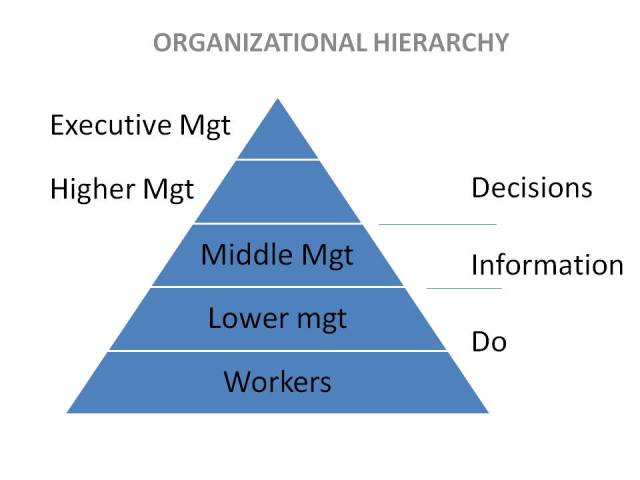
When the description above is combined with the three topics for every meeting as described in an earlier blog, you will notice that each of these levels of the corporate pyramid are focusing on one of the three levels, as shown in the picture below

organizational hierarchy

Breadth of experience

Usually, a corporation has several requirements for Executives all geared towards grooming them broadly enough for general management instead of just one specialized field. These requirements often are also made explicit: they need to have spent at least x years abroad, they need to have worked in multiple businesses and in multiple areas of responsibility etc. Some enlightened companies even have the possibility to count taking care of a needing relative as well, but that is not the case everywhere.

Most organizations have nice generic statements that the new entrant can choose where to pursue a career, as a Specialist or a Generalist. Some even add Project Management as a possible third career path.

Spoiler: generally, neither is completely true. The first myth is that Project Management would offer an equivalent career path as Generalists. Despite what some glossy corporate brochures might say, in practice, pure Project Managers can get up to a middle management level, but to progress higher you will need General Management skills. Project Management skills might help you perform, but that is all.

The second, broader spread-myth is that Specialists might have similar chances of advancement as Generalists. That is about true as the statement that a carpenter may earn as much as a manager: it only works if the carpenter learns general management or entrepreneurial skills. Most specialists also get stuck in the middle management layer. If you want to get an idea of what kind of specialists might make it to the top: look at the Management Board. Almost always, General Management and Sales will be represented. Less frequently Finance, maybe HR, maybe IT. If there is a picture of the Process Landscape, usually there are 3 layers, with the core process in the middle. Look at which processes are depicted on top, as “Management Processes”  as opposed to “Support Processes” at the bottom. Now which Specialists have a heavy say in the organization, do you think?


Management Development

Against this backdrop, new entrants are initially scanned into three categories:

  • Anybody with no university goes towards the lower management and workers.
  • Anybody with a university degree goes towards middle management
  • And a very few of the university degree entrants are selected as a high potential, or hipo.

Hipo’s typically are given a middle management or staff position. Ideal is to start as assistant of a Board member, where you get a first row seat on the major corporate decision making and where you can develop your relationships with the top brass. Crucial here is to get a ‘mentor’ who will take a personal interest in your development and where you can go and ask in moment of utter bewilderment.

To develop their potential, hipo’s need to obtain a broad array of skills and are sent around to different divisions. In that process, several of them just turn out to not have the skills required for the next step and they will get stuck or leave the company. Others get moved to just that area of expertise that they can not master. Whether that is true because of real skill gaps or character deficiencies or pure bad luck does not matter. Those are the victims of the ‘horizontal Peter principle’. Only those that avoid this pitfall make the step to the top and enter the “C-suite”.

Posted in Leadership | Leave a comment

A Taxonomy of Processes

When analyzing an operation, one of the essential questions is `Which processes are being performed´? It is interesting to see how many executive managers answer that question at a very abstract level, and operational managers often answer it so detailed that they loose the overview.  Still, the answer to that question at the right abstraction level helps in determining what kind of people you need, how you can drive efficiency through automation etc. A small side-effect is that it also provides the training plan for new employees.

This inventory of processes that are being performed (´taxonomy´ for experts) more or less provides the environment wherein the customer operates, and asks his questions, so it also determines the contact reasons. When registering contact reasons it makes sense to use this same methodology, thereby we supply valuable input for the whole Customer Experience (or User eXperience or UX) analysis. Below I will show a fairly simple example of how that works,.

The first dimension of a customer desire is determined by his viewpoint: where does he come from?  Is he a customer already? Or just a normal member of the general public? The second dimension is the objective this (potential) customer is trying to achieve in this situation. in other words: where is he in the customer journey? The third and final dimension refers to the challenge or joy he is experiencing in going for that objective.


Customer Category Taxonomy of Processes In- and Outputs
(Status) (Customer Objective) (Contact reason)
General public passive exposure  
  employment information  
  investment information  
  purchasing information  
Prospect product functionality  
  product availability  
  company information  
  pricing information a generic price list
    price for separate part/service
    get volume discount
    final negotiation
  ordering  
Customer registration  
  training  
  set up  
User initial use  
  regular use  
  providing feedback  
Payor comprehend & agree invoice  
  pay invoice  
Ex-customer cancel contract  
  post mortem review  


Posted in Customer Service, Operations | Leave a comment

Universal Business Process Pitfalls


Universal business process diagram

It has been several years since I wrote on this model, and it has been enhanced only so slightly. In the wording below the BPO-wording has been expanded to products to enhance it’s universality-claim. As always, it is more interesting to read about the things that go wrong than the ideal world, so examples of pitfalls will be given which can be understood with this model.

Diagram 1. Universal Business Process Diagram

bpo


Some general pitfalls

In every organization a balanced combination of various expertises is needed. All parties mentioned above need to be represented sufficiently in the (management) team for the whole to be successful, where every industry and every situation might require a different balance. Still, a ‘general wisdom’  is that the President of an organization best come out of it’s core processes, so the horizontal development of ‘accounts’ above. Several pitfalls should be avoided:

  • Sometimes the Financial Director has the ultimate say: danger is that only the immediate financial results count, and the organization is ‘bled to death’ through underresourcing. Insufficient tools are provided, and that has to be made up through harder work. The best-motivated employees (usually the ones with domain knowledge) are driven ever harder, until they really have no slack at all any more. Especially they see that some expenses are just ‘soo logical’ but they can not present their vision strong enough in the appropriate channels to get management approval. In the typical case, a saving on salaries is driven ´boiling the water for the employee, until the frog jumps out of the pan´.
  • General management might not position itself as a ‘third dimension’ overlooking the whole organization, but as a representative of the capital-providers. Although this might also occur with private companies, stock-listed companies seem to have a higher incidence of this trait. The same “Financials only’ scenario follows.
  • A periodic leadership by a representative of another Support or Production area might be useful in case of a calamity, but long term either this individual needs to pick up sufficient ‘core process’ affinity and experience herself, do the same within the team, or make way for one who does.
  • If the company is part of a larger family, the percentage of high-potentials should be kept in check sufficiently. Rough guess is maximum 20% of each layer. Where these hi-po´s might have exemplary personal skills and backgrounds, if they are in the subsidiary for only a fairly short period of time, they do not have sufficient time to gain the domain knowledge and apply it too, before they move to the next stage of their personal development. Yes, the larger family needs their skills since they will supply the next generation of overall leaders, but the danger is that – especially the smaller – divisions they visit on their way up are left without enough ‘blood to supply the oxygen throughout the body’. If I may believe some current articles on the latest generations, we run the risk of both the combination of limited supply of hi-po’s and their high demands for mobility make that organizations do not get the time to reap rewards sufficiently of ‘internally job-hopping millennials’.


Applied to Project Management

A typical project is like a typical company, with very similar challenges. To successfully implement a change, one generally needs 3 components: Client Domain Knowledge (the horizontal axis), Supplier Domain Knowledge (production, or resources and people), and Project Management Skills (process). By the way, it is amazing to see that this division of required skills also applies to some specific areas. For IT one can e.g. identify the 3 areas as: Requirement Engineering, Solution Architecture and Project Management. Careful readers will recognize some Prince2-influence in here. These 3 areas are needed in Services, where one needs to have been exposed to the (same) client on a regular basis to know how it feels like to report on promises that you(r organization) could not keep, and still tell the client that you would love to perform additional services, and that he really needs to put down his signature on that order form because you need to get paid for it. On the Supplier side, you need to have stood in front of a crowd of a hundred people and tell them that this year there will be no Christmas party because of financial cutbacks. Or have negotiated with the supplier to deliver square pegs and they deliver the pegs albeit square, but so large they do not fit in the holes you had drilled for them. And finally – the part that most people forget – one should also know some things about Change Management, better known as Project Management.

An ideal Project Manager has skills in all these 3 areas, but that requires quite some experience, and sometimes also luck in one’s career. In a lot of Projects, these areas are divided into 2: Domain Knowledge (combining both Supplier and Client) and Project Management. Generally the Project Lead is responsible for the Domain and is supported by the Project Support or Project Management Officer. The increase in FTE is partially explained by alignment between the 2 positions, like both need to attend the Project Team meeting, Review Committee Meeting, read reports, background materials and the exchange of information between the two of them. Some large companies have an HR policy that supports employees gaining expertise in both Expert, Line Management and Project Management positions. One of the nice results of such a policy is that one individual would then be multi-skilled enough to do a Project all by herself, a significant gain in Project Management resources! (Best guess: about 50%).


Some Project Manager pitfalls

  • Some people will confidently talk about the x-million $-project they have run, or how long they have been an ‘Production Manager’. That means that they think they know these fields, however, they might have been extremely successful in these jobs, but not because of their Project Management or Production Management skills. Circumstances, luck, great skills in one field crucial for that particular undertaking and many other factors might all have compensated for a lack of Project Management skills. A real Project Manager will give a certain assurance that ‘regular problems’ will be dealt with. I have sailed across The Channel, but trust me, I am not a good sailor.
  • A large Project only needs one captain – although I have also seen cases where multiple captains on a ship did work – which means that typically the Project Lead is ‘boss’. The Project Management Officer might have the ‘functional’-leadership on the ‘How’ but that virtually always should be subservient to the ‘task’-leadership of the ‘What’ represented by the Domain. Typically, a PMO is one salary group lower than a Lead, but there is no necessity to that.
  • Similarly, if a large project is run by a junior Project Manager, that does not necessarily mean that the Project runs afoul. The Sponsor just should acknowledge the discrepancy and take supporting measures: the Project Manager might be sent to a course, a coach might be provided, some extra expertise might be brought into the Project Team, more frequent Review Committees, and sometimes she just has to take a risk. Now if that situation persists for a longer period of time and the Project(s) are successful, it might become time to re-assess the qualities of the Project Manager who has apparently proven herself ‘in battle’.


Posted in BPO, Customer Service, Leadership, project management | Leave a comment

Constructive Criticism – an indication of diversity

Introduction

At this moment I have the privilege of updating a Project Management Directive as part of my project. Not something I looked forward to. Usually pretty dry stuff, where most people involved have to try and stay awake, which needs to be ímposed´ top-down, followed by numerous missionaries conducting trainings while trying to evade the psychological equivalent of Bonifacius´ fate at Dokkum.

Instead, heated discussions evolve, around topics like: the level of Sponsor required for a Project, which acceptance test questions to pose at which milestone, and the qualifications required for Project Managers, clarity of sentences, to name a few. People newly involved are surprised how ´hard´ these discussions take place and how much room criticasters get in the meetings. For me, all that criticism equates to presents. Let me explain.


Constructive criticism

If I stand in a room and declare it to be horrible, that does not add any value. However, if I state that the walls should be painted pink with purple dots, that is an alternative. Whether the owner of the room agrees or not is a different matter, I have provided an alternative by spending my time and thereby added value in the economic sense of the word. The owner can accept or reject.

When a woman I do not know passes by in a horrible dress, I will not make a comment about it. However, if my sister/mother/wife/friend does the same, I will shut up in public, but when we are alone feel obliged to make a comment about it. This all assumes we have a good relationship of course. Constructive criticism is an expression of the quality of the relationship. Something one should also keep in mind in relationships.

To take this further: if I have spent my time and effort to help the house owner improve his room, the choice is to him, just as the woman can decide to follow my fashion advice or not. (Generally the latter is advisable, to be honest.) Since the criticaster has invested this effort, that gives the criticized the moral duty to at least feed back what he has done with that feedback. Also and especially when he does not accept it, which is a rejection of the value add, and again criticism of the criticism.


Room for criticism

Criticism should be nurtured, regardless of whether the recipient agrees with it or not, the mere fact that somebody constructively criticizes should be acknowledged and protected. Especially in the beginning stages of a group, when the ‘norms’ are being set during its ´puberty´, it is very valuable to have a participant go ‘too far’ according to some in providing criticism: by doing so he proves that there is room for it and he paves the way for others to feel comfortable and bring in their comments. That drive, that ´Sturm und Drang´ is just as much value added as the content of constructive criticism.

In a more settled environment, of course all participants have the responsibility to provide criticism of a certain quality. That does not mean that the criticism needs to be shared by all, but succinctness and accuracy of wording are requirements in that respect to keep the discussion on course.


Diversity

Often, when presentations are held about new concepts, ideas or information, participants are away in their head, or even worse, even physically answering e-mails, since they “will get it anyway”. Until you ask them a question on-topic. Alternatively, everybody just listens to the Northkorean-style speech of the Great Leader and nods in approval. Those examples of unisonity occur often and do not add value per se. What does add value is asking the right questions – which is an art by itself – and bringing in suggestions for improvements or alternatives. Those ideas are by definition different from what has been presented before, and therefore add value. The more unique the position the more value it adds. Even when it goes beyond the ‘Veto’-threshold of participants, because it might help in opening up somebody´s eyes. Those value-adding ideas can only come up if the participants have a different mindset than the rest of the group.  Therefore, those ideas and constructive criticism are proof of the diversity in thinking of the group. Let’s nurture that diversity.

Even though Diversity might be in corporate slogans, that does not add value by itself. Value is added by showing diversity to prospective employees and attracting them, but the most concrete value lies in the constructive criticism it generates. That constructive criticism creates better decisions. Better decisions lead to better products, like the Project Management Directive that will help to implement better Projects.

Posted in Leadership | 2 Comments

Integrity and cultural differences

Background

Integrity is for me the consistency between my words yesterday and my actions today, so consistency in both the time dimension and the action dimension. Entering a different culture can expose oneself to phenomena one does not understand. Then I am not talking about corruption in a Third World country, I am talking about something totally acceptable in another Western culture in the realm of secrecy and openness.


Title inflation

When talking to a couple of German friends of mine I recently found out that in the German labor market it is totally acceptable to have one job title in your contract and another on your business card. Often it is an agreement between employers and young, upwardly mobile employees that they may already call themselves a title where they are expected to grow towards. The new title is agreed in the HR system, which makes it formal enough for some. This phenomenon is applied worldwide in politics as well, think of the Undersecretary of Trade that may call herself `Minister` of Trade abroad. This ´vanity´ phenomenon usually is in vain since everybody uses it, but for formal purposes it works. That in the labor market employers would use it to ´reward´ employees with prestige that does not cost money is only a cynical thought, of course. To what extent it is just plain lying to represent oneself with a different job title than one formally has, is again a different topic. I wonder if an employee that has used such a technique in the past elsewhere would fail the integrity background test for job applicants to these companies?

Even more, I think that it is counterproductive. If these usually bright employees accept that practice, shouldn’t that disqualify them for the fast track? Some computer companies in the end of the last century rewarded their middle management with different color waste baskets.  Today, most people do not recognize the names of these companies any more. Or how Western explorers could buy land from the native Americans for some trinkets. Is that really a history a company wants to be remembered by?

Wage secrecy

Another German labor market phenomenon is apparently a clause that one needs to keep one´s salary secret. A thinly veiled threat that in another country not long ago somebody has been fired because of violation of that particular clause is apparently a common accompanying utterance. Reasoning behind such a clause is that wage information is supposed to be competitive information. How a single salary could be such except for that employee applying with a competitor I fail to see, but that must be a cultural deficiency in my case.

There are some additional questions one could ask these employers:

*does it make us hypocrites if we then ask that question ourselves when people apply for a job with us? So do they refrain from that?
*will we try to stop an employee for answering the question `What is your current salary` when applying for a bank loan?
*from multiple Germans I understand that this clause can not be upheld in German court, does that mean we consciously make ourselves look incredible? For what reason?
*this clause, one might say, also goes counter to many corporate values. In most of them I have recognized variations on ‘openness’, ‘transparency’, ‘credibility’,  ‘integrity’, ‘trust’ etc.

Finally, there is such a trivial thing as the UN’s Universal Declaration of Human Rights (Paris, 1948).  In it´s preamble it clearly supports the right of free speech, and in Article 19 even guarantees the right to express opinions and impart (`vermitteln`) information.  In Germany, there are already 121,368 employees disclosing their salary (anonymously) on Glassdoor.de today. Even though that is only 0.28% of the total workforce of 43 mn that is a significant number proving that ‘society in general’ does not share this viewpoint.

Interestingly enough, for DAX-listed companies this number is proveably almost 20% higher, to which one should add the employees of these firms that did so without indicating their employer. (See table below this blog. Whether the peak of 5% at Deutsche Bank is an indication of the recent turbulences there I will lead to others to comment on.)

The privacy-argument does not fly – even in Germany. There is a difference between the employer publishing salaries or an employee publishing her own. And even that argument has had it’s use but also it’s longest time. Where first the salaries of top management of listed-companies became public, soon followed by those of most American presidential candidates, transparency on this subject seems unstoppable. I am afraid that the current proponents of this policy against self-disclosure will be ashamed of it 30 years down the road.


Alternative

Let me offer a different way of approaching the subject of salary secrecy. The major danger I see in salary transparency is in a salary explosion. It would expose all of our mistakes in the past in allotting excessive pay – especially for underperformers.  And it would impose upon us the professionality of being able to tell an employee that she is less valuable to us than a colleague. And how much. Therefore, we already should prepare ourselves for this inevitable occurrence and act as if that transparency were already there. So properly evaluate all employees (e.g. like Salesforce did) because otherwise this will bite us in the tail in the long run.

Furthermore, as a leader I am not afraid of transparency on salaries. I would have no difficulty in hiring people with a statement along the lines of “We standard pay x% less than market salaries because of the value we offer to you working for a company with the reputation of ours”. The discount to market is the true reflection of our brand in the labor market and in my humble opinion a great way of measuring the added value of HR. Whole Foods Supermarkets has been publishing salaries internally since 1986. Some companies like Buffer now openly publish their full list of salaries worldwide, I predict more will follow. This transparency is only possible if you have nothing to hide. Which would fit nicely with the values of most of us, wouldn’t it?


DISCLOSED SALARIES AT GLASSDOOR
OF DAX-LISTED COMPANIES EMPLOYEES
Company Prime Standard Industry Category Ticker symbol Employees (source: wikipedia) Salaries at Glassdoor
August 7, 2016
Number % of em- ployees
Deutsche Lufthansa Transport Aviation LHA 118,781 469 0.39%
Vonovia Real estate VNA 5,900 0 0.00%
Adidas Clothing ADS 53,731 260 0.48%
Allianz Insurance ALV 147,627 394 0.27%
BASF Chemicals BAS 113,292 212 0.19%
Bayer Pharmaceuticals and Chemicals BAYN 118,888 161 0.14%
Beiersdorf Consumer goods and Chemicals BEI 17,398 49 0.28%
BMW Manufacturing BMW 116,324 483 0.42%
Commerzbank Banking CBK 52,103 485 0.93%
Continental Manufacturing CON 190,000 260 0.14%
Daimler Manufacturing DAI 279,972 602 0.22%
Deutsche Bank Banking DBK 98,138 5100 5.20%
Deutsche Börse Securities DB1 4,540 66 1.45%
Deutsche Post Logistics DPW 488,824 243 0.05%
Deutsche Telekom Communications DTE 228,248 535 0.23%
Fresenius Medical Care Medical FME 105,917 36 0.03%
Fresenius Medical FRE 216,275 25 0.01%
HeidelbergCement Building HEI 44,900 14 0.03%
Henkel Consumer goods and chemicals HEN3 49,750 148 0.30%
Infineon Technologies Semiconductors IFX 29,807 137 0.46%
K+S Chemicals SDF 14,295 31 0.22%
Linde Industrial gases LIN 65,591 117 0.18%
E.ON Energy EOAN 58,530 231 0.39%
Merck Pharmaceuticals MRK 39,639 115 0.29%
Munich Re Insurance MUV2 43,316 182 0.42%
RWE Energy RWE 59,784 150 0.25%
SAP Software SAP 74,406 581 0.78%
Siemens Industrial, electronics SIE 343,000 1697 0.49%
ThyssenKrupp Industrial, manufacturing TKA 154,906 332 0.21%
Volkswagen Group Manufacturing VOW3 592,586 305 0.05%
DAX-total 3,926,468 13,420 0.34%
Germany 43.000.000*    121,368 0.28%
LEGEND
* DeStatis.de, January 4, 2016


Posted in Intercultural, Leadership, Transparency and privacy | Leave a comment

Project Management is more difficult than Line Management

Introduction
In a traditional organization, the hierarchy was simple: their were bosses and there were workers. With the introduction of the matrix organization, the distinction between line and functional hierarchies became apparent. As soon as matrix organizations became global companies ( or the other way around) legal departments enriched us with the distinction of a disciplinary hierarchy that might be a third basis or element of authority. An ever increasing speed of change and adjustment now forces  a similarly fast increasing use of project management in the corporate world. How to asses that authority?

Background
The commonly accepted view I have encountered is that disciplinary authority is a merely formal authority, not really a challenge. The functional authority of an expert often is not really appreciated: many companies proclaim that they have careers in ‘domain’ fields, but often a typical line management role is the only real variant valuable for advancing one’s career. How often don’t we hear traditional HR Departments refuse even the consideration of a promotion because the individual does not `manage a sufficient number of employees`? Even when more insightful, the line management role is ´always´ used as a reference. A middle manager in a German company is  ´Gruppenleiter`, ´Abteilungsleiter´ or ´Direktor`-level.

The order of difficulty of  different authorities or management forms then becomes, in increasing complexity:

  1. Disciplinary management
  2. Functional management
  3. Target or Line management


Project Management

Steering provided by a Project Manager to her team is often classified as ‘functional management’ and therefore less rewarded than target responsibility. Often I see that the project manager who has been steering a project team member all year long is not even considered in the evaluation of that individual!

The reason for this approach  I see in the mix-up between the concepts of on the one hand Project Management Office (PMO or Project Support Management), which generally is considered to be supportive and ´knowledge-based´ and is real ´functional management´  leadership, and on the other hand Project Lead Management, which does the execution of projects. For large projects there often is no centralized bureau assigning project managers, since the fulfillment of these roles is decided based upon domain knowledge. Therefore, the champion for project management generally is ´lower in the hierarchy´ focusing on the projects where a certain volume shows.

There are several reasons why Project Lead Management leadership  typically is more difficult than Line Management

  • A manager´s authority is easier to establish the longer she has responsibility for an employee. Large projects might have long timelines but are exceptions, most projects have short ones, so the Project Lead Manager needs to start all over more regularly and can not build on the infrastructure she has set up earlier.
  • In addition, it is not just the Project Lead Manager who is ´new´ in the role, this applies to all members of the team. Project timelines do not allow for long periods of ´Norming´and ´Storming´.
  • Line organizations are focused on providing a structure that ´makes sense´ and facilitates daily operations. As a result, often international or product  selections are the basis for  establishing the line organization. Project management is specifically chosen as a method when line management solutions do not suffice and interdisciplinary changes need to be accomplished. The intercultural aspect only comes on top.
  • In the real world we have to deal with imperfections, for instance when a project team is not complete. If there is a fair uniformity of activities performed as in line management it is relatively easy to find somebody within the team to pick up the slack. In projects the wide variety of activities makes other project team members just not capable to do so even if they would want to. Therefore, the Project Lead Manager needs to be prepared to fill in gaps in a wider variety of activities. Ideally, the Project Lead already  has  personal experience doing these tasks herself. If you want to implement a new Research Department, your best bet for a Project Lead probably is an experienced Research Department Manager.
  • The absence of formal authority means the Project Lead Manager has a smaller ´stick and carrot´ than a line manager, so will have to rely on ´soft persuasion´ alone.

So, am I arguing here to make project  managers (as in Project Leads) also line responsible for project team members?  No, only for multiyear projects where the project becomes ´the line´, not for most projects we see in everyday life. For those shorter projects shifting line managers with every project would mean an upheaval of the safety net and stability for the project team members. We then might as well use an interim manager or leased employee for that purpose. It would disrespect the long term relationship I would want to have with an employee.

Conclusion

I will argue, however, for an appropriate appreciation of  the challenges a Project Lead is faced with. Or, the order of difficulty of  different authorities or management forms then becomes, in increasing complexity:

  1. Disciplinary management
  2. Functional management
  3. Target or Line management
  4. Project Lead management
Posted in project management | Leave a comment