Addictions and separating channels

Channels

The main difference between man and animal often is considered to be consciousness. An addiction can be described as a persistent use of drugs despite substantial harm and adverse consequences, especially the loss of consciousness and thus our ‘humanness’ . Our current tendency to be ‘glued to our smartphones’ is like an addiction and take away consciousness. There is a fairly easy way against that by ‘separating channels’.

Traditional substances

Drugs – In the ‘War on Drugs’ with all of its local variations governments have been exceptionally ineffective: the effects of the usage of hard drugs have moved away from the public eye but the effects of the undermining effects of the drug-industry are unsettling, where in countries like The Netherlands an ever increasing financial and societal cost on the legal system with wanton killings of lawyers and witnesses reaching almost Italian levels.

At the same time, the half-hearted legalization of the recreational use of marihuana in e.g. the United States has mixed results on undermining.

Tobacco – The usage of tobacco seems fairly well under control in the world, although the stepping out of e.g. Philip Morris raises the question whether the challenge with tobacco will shift from (the effects of) use towards the undermining effects of supply.

Alcohol – Globally controlled and taxed, where little or no undermining effects are seen after the U.S. “Prohibition” but a continuous usage problem worldwide

Sugar and salt – Obesity is one of the great still fairly unrecognized upcoming crises. Governments have been spectacularly unsuccessful in reducing sugar or salt levels despite formal agreements to that effect, but undermining has not really been an issue with multinationals formally adhering to local laws.

Mental addictions

Gambling – With government-controlled or inspected casino’s, the usage effects seem to be fairly well under control. Rumors of undermining in the industry can not be substantiated here.

Television – Often not seen as an addiction, but how many people spend most of their time watching TV? Whenever I come home, I see one of my neighbors sitting in front of the television, one of my elder relatives (deceased by now) was known to have spent all of his time after retirement on the couch practicing remote control. Social clubs like choirs, music bands, chess clubs etc. are on the wane because of the easier escapism offered by the ‘tube’.

Video games – About 10 years ago already an addiction expert stated that the main addiction he was treating had shifted from substance abuse to video game addictions, where youth would be escaping from the institution to participate in nightly in-game raids with their group or clan. Whereas Global Box Office revenue for movies was 42 bn US dollar in pre-COVID 2019, the Global Video Market revenue was with 150 bn, more than triple., with the Asian market at 72 bn US dollar almost already double (Source: http://www.Statista.com). The Chinese government has imposed a three-hour limit to video games on their youth per week as of September 1, since 50% of their population play on average more than six hours per week. In Western Europe such limits are considered by some to be ‘undue use of parental authority’ and in effect have become virtually impossible to monitor through the movement to mobile games.

Social media – the growth of usage of social media in general is obvious, the growth of Facebook/Meta and Google and the ever-growing screen time is evident.

News – partially overlapping with previously mentioned addictions, the lure to the TV by the 8 o’clock News, often followed by a continued viewing of the programs following afterwards. However, also the continuous checking of news sites for updates. Whereas the dopamine flowing from ‘being in the know’ used to be triggered by reading a newspaper or a magazine, there now is a consistent pull by updates from news sites. And because we use our smartphones for all these other functions, from alarm clock to communication and so on, the seduction is continuously ‘in our face’.

Conclusion

Whereas some readers will concur that the moderate consumption of most of these addictions is not a problem per se, the challenge lies in the ubiquitous exposure to mental addictions for modern man: whereas for the physical addiction one needs to go to a shop – where one might already need to be anyway for groceries but still – but the unification of media makes the mental addictions virtually inescapable. The growth of screen time seems unstoppable and limitless, leading to a loss of consciousness for our species. A dystopian future where mankind is fed and entertained as a domestic animal for energy production and entertainment of a more conscious species comes one step closer.

Still, we are not completely powerless because the choice of our channels generally is a more conscious one. Here we can more easily take control: the workaholic can separate the business mobile from the private one, we can play games only on consoles or a specific laptop, uninstall news apps and read the newpsaper, and even – lèse majesté twenty years ago – not replace the broken television.

Good luck with leading a conscious – human-worthy – life.
Posted in Uncategorized | Leave a comment

Artificial Intelligence and Freedom

Introduction

Artificial Intelligence (AI) generally is based on Deep Learning, where a decision-making process is divided up into numerous small little steps leading to a certain likelihood of an outcome. Often, these steps become too complex for a regular person to understand. Whereas this technology offers great possibilities for progress, it also threatens personal freedom if implemented arbitrarily. That AI is going to take over decisions in a modern society is inevitable and necessary to sustain society’s increased complexity, but it is essential that both the ultimate decision needs to be made by a human being and that the decision-tree remains transparent for all involved.

Problem description

In most parliaments rules are introduced with a keen eye on public opinion but less on administrative execution feasibility, let alone ‘sturdiness’ or the avoidance of individual subjects falling in between the cracks. In addition, the public outrage in case something goes awry – which sometimes just happens to be part of reality – is a grand motivation to becoming ever more risk averse, and thus to regulate into ever more situations. As the administrative apparatus does have physical limits, a growing support by (ever more AI) technology becomes inevitable. As long as situations are standard, AI likely will predict the correct outcome and serve the populace well. However, there is only a likelihood of accuracy and exceptions to an administrative rule will remain and due to ever increased complexity of rules increase in number.

In the European Union, for example, there is freedom of movement in principle. In practice, there are many exceptions to this rule. Below we will examine actual examples out of the life of one single person, who just happened to move to foreign countries a couple of times. The importance of the population registrar and the challenges offered by frequently moving address are shown in these examples, all derived from the life of only this one individual. Fortunately, he was well-educated, white (or ‘pink’ or ‘Caucasian’), born in the EU with a European passport, and he spoke the languages. Imagine how these barriers would work for those less fortunate, or those numerous refugee, whether political or economic, that we are sheltering.

  • Our ‘(anti-)hero’ turned in effect homeless when he returned from living abroad to his home country looking for a job and the last city he lived in refused to let him register for (social) housing because he had only lived there for three years. The previous city, where he had grown up, did the same because he had moved to another city within the country afterwards.
  • When he divorced and moved out of the marital house, he needed to wait for seven years before social housing would be made available to him (agreed, here he probably better had been a refugee).
  • When moving to another country within the European Community he was kicked out of the health insurance because of his new foreign address.
  • When moving back that same health insurance refused him without a citizen registry change. When that change occurred, the insurance unilaterally insured him not per that date but per the original request date, making him double-insured. When confronted with the anomaly the insurance second line refused to correct it but referred to a central government legal committee for rectification.
  • When wanting to exercise his legal right to put in a complaint, a policeman demonstratively tore up the complaint in front of his eyes. (Both a police lieutenant and the mayor later apologized for this aberration but only after persistent follow-up on the content.)
  • When living in one and wanting to move to another European country he found a job in the new country. However, a mortgage advisor refused to take him on as a client to finance a house, or even to call him back/talk to him on his foreign telephone/Facetime/Whatsapp number or let him open an account merely because it was still living outside of the country.
  • He was told that he could not open up a new bank account with a particular bank in the new country since the institution absolutely refused ‘still foreign addresses’ given the bureaucracy involved due to their ‘money laundering’-challenges.
  • More examples are there but that is not the point and would burden this piece to boredom.

All of these challenges he could overcome because he had sufficient income, determination, language skills and procedural knowledge. For a regular refugee without these resources these obstacles would have been fairly insurmountable.

Frequency of problem occurrence

Our Western European society boasts ‘free internal movement of people’. In practice it does not support them. Still, the local binds are loosening and ever more youth are moving from the countryside to the city. Ever more students are studying abroad. Ever more workers are crossing borders as well, as evidenced by – not only – the Brexit fuel-driver problems. The legal crossing of international barriers is increasing significantly, leaving aside the additional illegal crossings.

At the same time local regulation grows, the number of local law books has proliferated, and the issuing authorities have grown with the central EU-bureaucracy – another source of prolific regulation. The execution of rules does not have primary attention at their creation. The ‘Toeslagenaffaire’ in The Netherlands is an example where citizens were (and despite Prime Ministerial excuses and the fall of a cabinet some still are) grinded between the mill stones of government agencies.

A parallel development is the ‘throwing over the fence’ by central governments to local ones, where the execution of regulations is ‘delegated’ with insufficient funds. This ‘political strangulation’ puts ever more pressure on the execution of regulation by local governments. Not only the police needs to prioritize where to enforce, also the mayor’s office needs to decide which parties yells loudest.

There are two main approaches to such complexities: the inherently best one probably is ‘Pushing Back’ and have regulations reduced. For simplicity’s sake I will here consider that method as impractical. The most feasible and thus most likely one seems to be automation, with Robotics Process Automation (the automation of manual administrative steps) and AI Deep Learning as main potentials. It is my expectation that both will be implemented widely in the coming years.

If processes have been documented properly, they show not only the steps to be taken for every conceivable situation but also which responsibility every party has in that process. The most common ways of explaining responsibility is via RACI or RASIC. The most crucial ones are the R which stands for ‘Responsible’ or the person doing the work and the ‘A’ which stands for either ‘Accountable’ or ‘Authorize’ who needs to take the decisions. A fuller explanation of these methods you can find in a previous blog the-ida-ly-cycle/  Unfortunately, quite a number of government measures are implemented under great publicity and time pressure, which bodes ill for proper and esp. complete documentation.

If there is no room for deviation to the bulk of the situations, there will be no freedom left, be it of decision or of action.

Requirements or solution

The term GIGO also applies to AI. But AI brings in an additional danger, namely that of human incomprehension and undue respect, like a reference to ‘AI decided it, and AI is many times more intelligent than I am’. Make no mistake: Artificial Intelligence is a great ‘R’ to do the work, but there are two hard requirements for each and every implementation:

  • the procedure always will need to remain a human who is the ‘A’ of Authorize. Artificial Intelligence should never be allowed to make decisions, only support the decisions of a human being by doing the hard work.
  • allow for a regress-procedure with human pragmatism and intelligence to overcome mistakes. In the speed of progress we will make mistakes, and we will need to make mistakes for progress (“Fail fast”).

Or, in short, a human should oversee AI and take the ultimate decision. The moment we hand over that responsibility we hand over our freedom.

  • Oct 6 Textual edit
Posted in Uncategorized | Leave a comment

Big Tech: publishers or search engines?

There are two controversies currently playing up with respect to the role of the ‘Big Tech’ at this time. The first one is about whether Google should pay royalties on the articles shown via their technology. In France apparently Google has cut a deal with publishers to do so, in Australia a law has been passed ordering to do the same there – which has been met by staunch resistance by this tech company. The second is the question about fines to Google, Facebook and others for wrongful content, having their subscribers not properly adhere to ‘fake news’ distribution (‘censorship’) laws. This topic runs parallel to allowing these companies to censure their subscribers: whether Twitter has the duty to ban Donald Trump’s account after the storming of the Capitol and Linkedin or Youtube in their own versions of bans. Both of these controversies are linked and intensely related. To understand how, we need to do some further analysis by distinguishing between two potentially different – and mutually exclusive – roles of these platforms.

Publisher

First of all, if the techies fulfill the role of publisher, their algorithms may be proprietary and their role is similar to that of any newspaper: selectively bring news to the audience, which has chosen the publisher on the basis of their reputation. The main difference between the bubble of Facebook and the bubble of any regular newspaper is that Facebook’s bubble is personalized. It provides added value by selecting and editing information, not unlike a publisher does. Facebook earns it’s money by selectively bringing certain information and advertisements to optimize screen time and revenue potential. In such a role, it would behoove them to pay royalties like any other publisher would do.

At the same time, a publisher takes ownership of the content and therefore is responsible for any slander, discrimination etc. Censorship does not exist in this role, it is called ‘editing’. Thus, in such a role, nobody should complain if their account is banned, similar to a journalist whose submitted article is not being printed.

Search engine        

The second alternative role is that e.g. Google is a pure search engine. Currently the search algorithm is personalized via a proprietary and unknown method but a real (‘honest’) search engine will provide answers regardless of the person asking the question. This difference is analogous to the difference between a fact and a point of view. As such the service provided is a tool, which provides ‘objective’ (access to) information, which might include the IP-address of a poster; any legal retributions would fall in the government domain. With a proprietary search engine, there is a basis of manipulation: the user expects to be provided real data, but is partially fed ‘tailored’ responses. In such a ‘pure search’ role, it would be fitting for the search engine not to pay any royalties at all.

Also, in this role fines for Google for allowing contributors to slander others would not seem appropriate, these should be borne by the originators of the content. It might be convenient for governments to fine Google and Facebook for not ‘properly managing it’s content’, whether it is appropriate – or a proof of their own incompetence – is another matter. Censorship of public domain is, if applicable, in my humble opinion, a government task. Not only are Western governments handing some of their core responsibilities away, it also makes a few private companies responsible for that censorship, leading to an inordinate centralization of power – and does not befit a real search engine.

Distinction in roles

Below a brief comparison of aspects and roles

TWO ROLESPublisherSearch engine
AlgorithmProprietary
‘(Commercial)’
Public
Content controlEditingNone
Penalties on contentYesNo
RoyaltiesYesNo
Comparison of roles

So far so good. However, the most profitable position is a mixture of both, which is what Big Tech has gotten away with: the claim to be an impartial search engine, while at the same time selling the edits. That by itself does not make the parties morally deficient, but introduces a constant seduction: there is a constant push towards promoting one role while invisibly performing the other. We see Google promote itself as a search engine but sell the results to providers. Amazon promotes itself as a marketplace but at the same time sells some products itself as well, competing against it’s own marketplace holders. That used to be called ‘channel conflict’ and ultimately will turn against the actor.

The defense of Big Tech might very well argue that this blog ‘does not understand the nature of high tech’ and the ‘intricacies of modern technology’ that there is a third option, which is a search engine which should not pay royalties but with a proprietary algorithm. I am open to examine the possible argumentation for such a position, but must admit I have not been able to find it yet. So, my current hypothesis is that ‘some people are trying to have their cake and eat it too’.

In the end, a choice will have to be made by both Big Tech which role they strive for and governments which roles they will allow. The later the choice is made, the harder the adjustment for all parties involved. Until then, mainly the lawyers earn a good living off it, as a consumer I feel misled, and we allow governments to create a dragon they can not control. A dragon that is slowly eating up freedom of expression.

Posted in Transparency and privacy | Leave a comment

Simpler Systems Integration

The general practice of working with Requirements from Clients and a Scope Of Work from a Supplier, trickling down throughout the chain of Client – System Integrator – Supplier – Sub-supplier might be ready for simplification, saving all parties (so ultimately the Client) significant time and money by working with one Scope Of Work throughout the whole contracting chain.

Problem description

For the more complex projects a Purchasing Department regularly works with a structure where the Client first describes a Requirements document, in case of formal tenders often in the form of a Request For Proposal. Suppliers of solutions then respond with a Scope Of Work describing what exactly needs to be done, this Scope Of Work often becomes the basis for the contract governing execution. The underlying reason using a combination of these documents is that a Client usually is pretty capable of defining the ‘What needs to be done’ but much less the ‘How it needs to be done’, which is exactly the reason to outsource to the vendor.

Such a procedure requires quite some legal and negotiating effort to ensure alignment of both these documents and in many industries profitability of vendors is determined by how minimized they can bid for the work – and price accordingly – to get it awarded, and then earn their margin from the changes or upsells. This method of working provides a devilish incentive for the Supplier to ‘seem to have agreed to fulfill the contract’ but to exploit errors and omissions in the Requirements to the detriment of the Client. This situation is quite similar to when a consumer buys a newly built-house and then finds out that the kitchen is really basic but for a royal fee a better-fitting kitchen can be built in. These changes all need to be negotiated again, which macroeconomically leads to a significant ‘overhead’ in administration. Ultimately, the Client pays for this of course. New, inventive contracting methodologies, like Vested ®, are coming up to optimize the Client – Integrator relationship.  This blog focuses on the documentation in the relationship, regardless of how that is formed.

Note: purists might want to point out the differences between a Scope Of Work, Statement Of Work and Work Breakdown Structure. For readability’s sake this distinction is not elaborated here. For the same reason I will leave all the various different steps and documents in an RFP-process out here as well. The same applies for Main Contractor, General Contractor and System Integrator. These nuances are relegated to academic papers outside of this blog.

Design, Build & Maintain

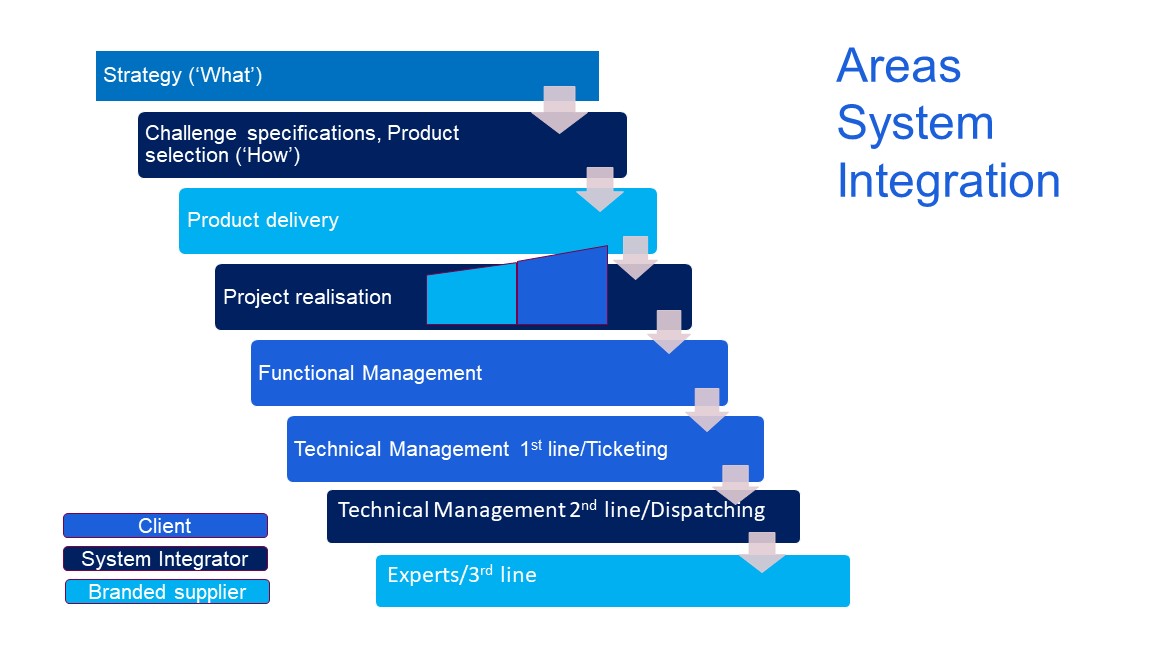
And it can become worse: within Design, Build and Maintain (DBM), like large buildings or technical installations, a further complication is brought by the frequent interactions among the various steps in the process: the initiative is passed back and forth among the parties depending upon the stage in development. The following diagram shows the myriad of interactions – and thus possibilities for handover failure in a simple situation with only one sub-supplier.

Proposed solution

One way of circumventing both the resulting bureaucracies and the possibilities of error and misunderstanding could be the writing of one Scope Of Work by both Client and Systems Integrator and then sharing and amending this document with the various suppliers, to be used as a basis for their own Work Breakdown Structures, RASIC, and thus pricing. When contracting out, all parties should be amenable to adjusting the Scope Of Work based on the inputs of all other parties, but maybe even more importantly: by allotting responsibility of the tasks clearly to the responsible participants.

There are several requirements – or risks – for such a simplification to work:

  • the Client and the System Integrator need to have a strong Master Service Agreement guaranteeing the integrator their place in the value chain. If the various roles in the project have not been set up clearly, too much time is being spent ‘jockeying for position’.
  • the same applies to the relationship between the System Integrator and the vendors. Ideally they also have worked together for other Clients to build on these experiences (a regular clause in RFP’s).
  • the Supplier and the System Integrator need to have a clear agreement about communication lines: it might be tempting for vendors to communicate directly with the Client – often on the basis of informal contacts ‘just about this small detail’ – but that practice has a tendency to gradually grow a relationship off kelter.
  • all parties need to be willing to investigate into larger project team meetings where the agenda will be dominated by items they are not always directly involved. Especially with large videoconferences the tendency of ‘tuning out’ for significant blocks of time is lurking.

Still, these risks are minimal given the speed of action, improved transparency and reduced bureaucracy resulting from one ‘Version of the Truth’ which is possible with today’s technology. Let’s use it to our advantage!

Posted in Uncategorized | Leave a comment

Be Brief, Be Gone

There are libraries full of self-help books about professional-improvement, showing how one should behave to get ahead. This blog produces a shortcut on how to assess the generic contribution of oneself but also of other people.

The most basic indication is the degree to which a counterpart focuses on listening or speaking. In a typical conversation the inept only speak, the capable mainly listen and ask. Bad sales people dwell on product features, good sales people ask for identifying customer needs. Or, as the Germans say “Wer fragt, führt”.

Typically, some counterproductives are also very persistent in their sending on content level only. They repeat topics over and over, sometimes from different angles but not always. In case another speaker tries to intervene at a process level, they refuse to get out of the content. There is a very fundamental reason why in formal discussions like in parliaments a ‘point of order’ takes precedence over a ‘point of content’. (Again, the Germans: “Störungen haben Vorrang”.)

On top of it all, a typical counterproductive counterpart is very emotional, which not only prevents himself from being rational and to the point, but also invites others to become emotional and divert from the topic on hand.

One of the clearest indications that somebody has little value to add to a conversation is when the contribution focuses on the history of how a situation came about: ‘He said this and then I responded that’ and variations thereof. In principle these descriptions focus on Information only, whereas often the Analysis or Action part are more relevant. (See also my blog on the ida-ly-cycle.)

As a summary, the (usually non-) succinctness of a counterpart indicates the level to which she can get to the essence of a situation. A speaker who is to-the-point allows the listener to both save effort to sift through the details and time to discuss the topic. Einstein’s quote about simplicity and genius may be considered to be well-known, and definitely applies here. The higher one gets into the organizational hierarchy, the higher the time pressure on agenda’s, so if one participant is too verbose she not only does not add value in a discussion of a certain level (‘belong there’) but also her contributions become obstructive to progress on other topics.

How do you score on these points?

Posted in Uncategorized | Leave a comment

How does an Android user learn how to make a screenshot with an Iphone?

Or: about User Interfaces and loss of useability

Photo by cottonbro on Pexels.com

Background

When we started using computer programs, complete educational programs were established to convey the knowledge of using FORTRAN, COBOL etc. In these trainings both the functionalities for the user and how to realize these results (the User Interface or UI) were covered.  Once moving to simplified applications for the masses like Word, Wordperfect etc. the trainings on these programs became separate and profitable business lines. There are people who would argue that the profits on trainings were one reason for Microsoft to change their User Interface with every upgrade. (And some that this opened the door wide for Apple.)

Apple, on the other hand, had a totally opposite strategy: make the Graphical User Interface so intuitive (with the help of those graphics) that no training was ever necessary. Whereas that might have been true initially, with the expansion of functionalities it meant that they ran out of obvious unambiguous graphics. True afficionado’s would have acquired significant experience in other Apple tools to find the supposedly intuitive functions whereas new converts would be punished for not having submitted to the Apple-religion earlier. The Apple Graphical User Interface works because for one it is well-designed, but also because it assumes full immersion into the system. Those ‘hanging in between’ Apple and Android are left with managing multiple User Interfaces, and sometimes bewilderment.

Modern times

So far the strategies of big, market dominant players. Many new (small) software providers do not have the market presence to be able and ‘extract a training fee.’ So, in a market where also the rise of Apple and the supremacy of their intuitive GUI has given many of them the legitimacy to claim that their GUII is also supposedly ‘intuitive’.  In practice most are not – and the multitude of different GUI’s defeats the purpose – but it saves them time and effort to spend on educating the masses on the use of their application. Of course, these applications can not become successful if users in general do not fully grasp the functionalities. However, if we look at the distribution of videoconferencing applications as an example, we can observe that these are driven by a core group of ‘evangelists’ who use the application often (or like an IT-Department, prescribe their usage) , where most of the users reluctantly are being standardized in that usage. Those that are forced to use multiple of these systems (e.g. Skype for their internal company usage, Microsoft Teams for one client, Google for another and Zoom for the charity board) are not only confronted with different technical requirements, exclusions because of safety precautions but most importantly with different GUI’s leading to the recurring question: “I know I can do this functionality somewhere, but where do I find it again?”

Similar but less contentious to ‘Information bubbles‘, these User Interfaces lead to segregation into user groups. A couple of decades ago fairly innocuous User Interfaces like faucets haunted international travelers with old showers that did not respond fast to changes in temperature (do they turn to the left or to the right for warm? or forward or backward? And, by the way, do we measure that on the top or at the bottom of the circle?) Fortunately, now there is an easy trick to find out for modern showers: quickly turn in both directions and in one direction you will find a block. That is the 37 degrees Celsius block from cold to hot. Problem solved.

The User Interface is gradually becoming ever more important: only hovering over a link will automatically activate it, a video pushed to your timeline will automatically start playing, and also ever more annoying: in some timelines – e.g. Twitter and Linked In – content will jump on the page because a new ad needs to be ‘pushed in’ so that the content you wanted to click on suddenly disappears. Oh, and navigating via the bar on the right hand side gets you into a rollercoaster of inputs without too much control. Most of these ‘improvements’ seem to come from the need of the pure evangelist user – and the interest of the software provider to control the attention span and nudge the user. The ‘average Joe’ user is – due to a lack of alternatives and ‘voice’ – forced to comply, which is exemplified in one simple use case: How does an Android user learn how to make a screenshot with an Iphone? Or the other way around.

So far, these effects are just part of the mechanics of the capitalist market, nothing morally abject to it, maybe just frustrating to people insisting on their independence of a technology provider and freedom. Now here might be a (common use?) opening for a product catering to this group, a technological equivalent of the solution to the ‘faucet dilemma’ mentioned earlier.

Proposed solution

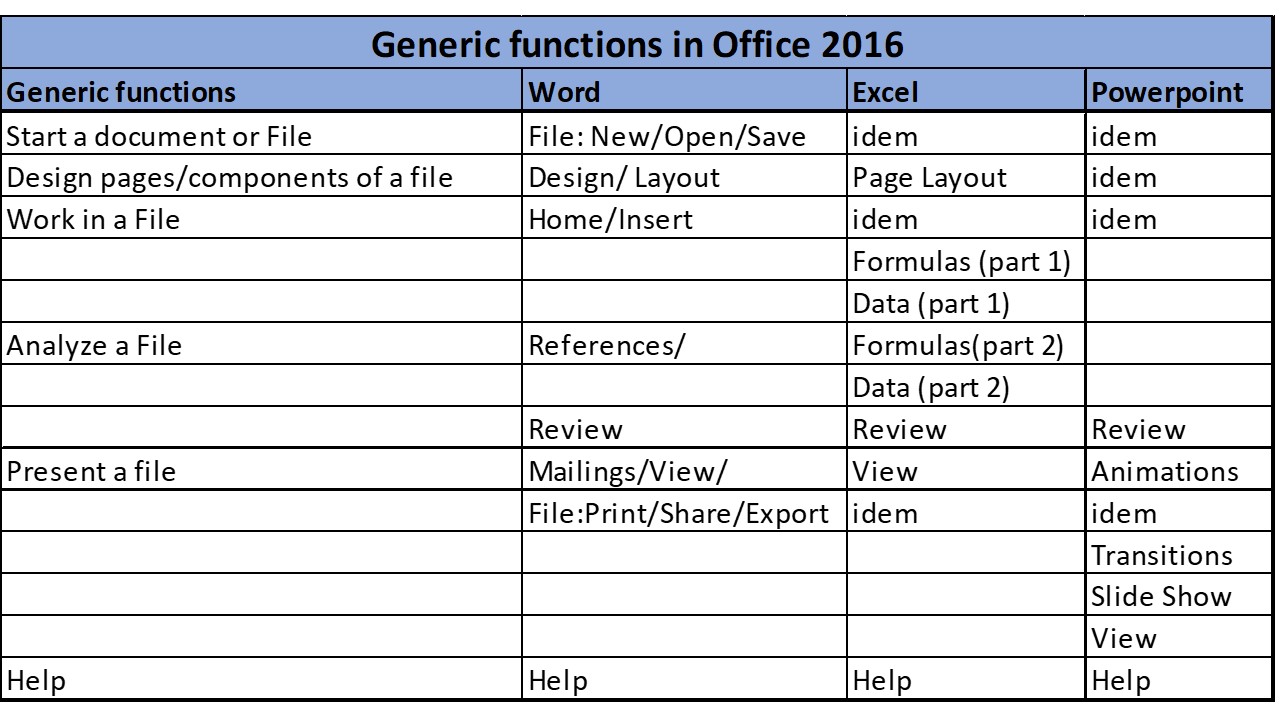
Therefore, I propose a standard for a back-up menu: a typical way of arranging features so that the uninitiated can easily find the feature of choice, not only with the ‘how to’ but also the ‘where to find it’.  Below a sample based on some Microsoft 2016 applications, probably the most widely known basis.  Any other basis would do as well., as long as it has been standardized. Only top-level has been worked out here, to show the principle. Wouldn’t a world where all Microsoft, Apple, UNIX, SAP, Oracle and other applications have a similar menu structure be a great achievement?

Posted in Customer Service, Uncategorized | Leave a comment

The difference between Strategy and Tactics in practice

While there often is a lot of ego involved in determining which individuals are supposed to act on an operational, tactical or strategic level in an organization, it makes sense to develop more objective measures and assist in determining who should do what – and whether the right people are placed at the right level of alignment. Based on these activities the positioning and the frequency of the governance levels follows fairly naturally.

Different activities

The basis of all organizations are the people doing the actual work, whether these are the laborers building an office, the bank employees helping the clients or the IT programmers coding the software. To coordinate these activities, whether that is done by a Project Manager, Scrum Master, Team Leader or a self-steering team, the Operational level takes responsibility for the planning of activities. When process descriptions and/or FTE budgets also come into play, a more Tactical viewpoint is needed. Whereas in smaller organizations often these functions are picked up by other levels, in larger organizations often this alignment is done at a separate, managerial level, where additionally the planning of people is being performed.

A typical Board in turn further facilitates the collaboration of people or departments and often uses organization charts to facilitate this. Participants ideally are capable of performing the activities at their level but also those of the more concrete levels ‘below’ them (they ‘know the industry’), or at least understand these so that they can communicate with the relevant representatives. The further away in the organization, the less knowledge of the underlying activities are needed at a Board-level. The table below gives a brief overview

LevelManagementActionsDocumentation
StrategicBoardPlan collaborationOrganisation structure
TacticalManagementPlan peopleProcess, FTE Budgets
OperationalCoordinationPlan activitiesPlanning
WorkActPerformActivities & Objects
Table 1: Different levels

Timing of Governance

The more abstract an activity becomes, the more time regularly is needed to perform these activities. Therefore, as a rule, the ‘more concrete’  a level, the more frequent alignment is needed. Another factor determining the governance is the degree of urgency. This level of urgency can be distinguished into ‘regular’, or when a change needs to be implemented ‘Project’ going all the way to a real crisis-mode. In the current Corona-crisis even the U.S. President engages in a daily press conference, in other countries a weekly update seems to be judged sufficient by their leaders. This frequency of meetings is one indication of how much control these leaders feel in this situation. Below an overview of some regular meeting intervals.

Meetings
LevelRegularProjectCrisis
StrategicQuarterlyMonthlyWeekly
TacticalMonthlyBi-weeklyDaily
OperationalWeeklyWeeklyDaily
WorkDailyDailyDaily
Table 2: Meeting intervals

Application

When determining the governance structure of a project, cooperation, division or department it often is helpful to assess what topics need to be discussed and how much urgency plays a role. As soon as there is consensus on these topics, the relevant personnel decision becomes more obvious this way.

Posted in Leadership | Leave a comment

How do we obtain a sufficient number of immigrants?

Introduction

The political ‘discourse’ on political refugees overshadows and blocks unemotional (not to use the word ‘rational’) thinking on a topic that is closely related but significantly different, that of economic migration. In discussions on refugees I hear many a participant speak derogatory about (the rights of) economic migrants. I am an economic migrant: four times in my life I crossed a border seeking a better life, three times for professional reasons, one time for love, never in fear of persecution. When I speak to current students a semester or study abroad is normal for them, of course this is also a form of economic migration. There are only two relevant distinctions between these individuals and a typical sub-Saharan African ‘refugee’ – indeed, skin color is not one of them – a European nationality and an on-point professional education, to which I also count language skills. Below an argument will be delivered not focusing on historical evidence about the benefits of migration in the past but on the current need to facilitate these flows of individuals. For their benefit but also for our own.

Problems

First, in The Netherlands there is a lack of dentists, plumbers, welders, technicians, teachers, policemen, care takers, nurses and so on. The Dutch government even publishes a list of difficult to fulfill positions. Unemployment is at an all-time low, so activation of the unemployed will not bring much relief here. With the baby boom retiring there is plenty of data predicting that this dire need will only increase. From a purely theoretical perspective, there are several solutions possible:

  • Increase fertility
  • Increase mortality for the retired
  • Increase retirement age
  • Increase productivity
  • Increase immigration.

Given the obvious non-immediacy, immorality or impossibility of the first four, only the last one remains – even with all of its difficulties – the only one that is anywhere close to feasible.

Second, the operational aspect of immigration is often underexposed: speaking to people ‘in the field’ I hear that not only when refugee centers are opened a lot of societal unrest is created, also when these same centers are closed the same phenomenon occurs. (Unclear whether from the same individuals.) From a purely managerial perspective it is clear that the COA (Central Refugee Agency) needs a certain minimum volume of work to maintain a core staff and facilities, in order to upscale in times of crisis. Or, the Refugee organization needs a certain minimum number of individuals to process to maintain (both a career perspective and employment stability for) professional staff.

Third, media reported that a Vietnamese woman that died in a truck had paid 35.000 dollar to get illegally to the UK. An Afghan acquaintance in Germany told me that his nephew had loaned 4.000-5.000 from a loan shark, who would break his bones if the steep interest would not be paid on time and in full, so in effect significantly more. The mere absence of a legal title increased the price of a trip with several thousands of dollars, several months of time and significant lethal risks.

Fourth, currently refugees and immigrants are not allowed to work while they are in refugee shelters. That means that mainly boys, mainly in their early twenties, are forced to be idle even though they are willing to work. As a man I can assure you that as an idle boy in my twenties I would have been up to no good in such a situation. And just imagine what this means for the development of their work ethic. Furthermore, the best way to integrate is to work, it develops language skills and social cohesiveness facilitating further integration.

Solutions

Taking all of these issues into consideration, we could consider the following solution directions:

From the moment a refugee or immigrant has been registered in our country they are allowed to work in specified jobs where they do not displace Dutch nationals. Those specified jobs are to be defined, but could be jobs in mainly government-paid institutions or those difficult-to-fulfill jobs. If the immigrant finds such a job and obtains a contract, he obtains a longer residency permit. The duration of the procedure is the responsibility of the COA, the more time the COA takes, the longer the immigrant has the option to find work. One of the requirements should be that the identity (and nationality) of the refugee or immigrant is known to ensure the possibility of extradition in case of lawbreaking or no job-finding. Not being an expert in the field I do not dare to predict, however, having a little bit of experience in managing people I dare to expect a decrease in crime and societal undesired behavior by those refugees and immigrants allowed to work.

Also, apparently foreigners are willing to invest heavily in getting their best and brightest into Western Europe. This resembles how Western-Europeans pay for their best and brightest to study abroad as well. With those thousands of dollars the equivalent families outside of Europe can gather, we could select workers abroad, have them pay for the regular (open return) plane ticket themselves and live in a refugee shelter seeking jobs. This way the COA could also house immigrants and ensure their minimum capacity. A nice side effect is that this option would provide competition to human traffickers, whose illegal 5.000 dollar-and-up option would seem overpriced compared to the legal variant.

Of course, the two possible solutions above are only described high over, both will encounter many a difficulty in detailing them out. Still, they do provide a pragmatic way forward, where one solution may solve two problems at the same time.

Posted in Uncategorized | Leave a comment

Process and Procedure

Introduction

In daily business life I sometimes observe a frequent passivity and helplessness by managers who exclaim: “There is nothing one can do about it” often referring to the action or signature needed from an obstructing party and tremendous bureaucracy set up by an overly cautious controlling department stifling all business acumen of managers ‘in the field’. Although not in the organizations you and I are working currently, of course. With a simple mind-trick this barrier can be overcome.

The words

To resolve such situations we first need to dig a little deeper and make sure we properly understand the words we are using. The first key word is a process, which is according to Wikipedia “ … a set of recurrent or periodic activities that interact to produce a result.” Let’s compare that to a procedure, which is according to ISO9001 “ … a document that instructs workers on executing one or more activities of a business process. It describes the sequence of steps, and specifies for each step what needs to be done, often including when the procedure should be executed and by whom.”  The key difference to observe are the ‘when’ and the ‘by whom’.

For good measure I will also address the term work instruction which “…would provide more detail, for example the tools to use and how precisely to use the tools to carry out the procedure.” These tools in practice mean an explanation of screenshots etc. So a process or a procedure could be identical in two organizations, but the work instructions on the other hand could be completely different because one is employing SAP and the other Oracle.

The interpretation

One could argue that a process is purely descriptive whereas a procedure is prescriptive. The latter makes absolute sense in legal trajectories, where a house can not be sold without a signature from the house owner, and the notary public, of course.  In normal business there are also a certain need for risk reducing procedures: a contract of a certain value needs a signature of a person properly authorized to commit the organization for that amount or topic.

However, our society sees a risk-reducing tendency: somebody dies because of a mechanical error and all kinds of precautionary measures are being installed. This has brought us seat belts, airbags and the ABS braking system in cars which are good. In other industries similar developments can be identified. In care for the elderly something similar has happened: excesses like patients chained naked to a wall because the caring home did not have (or prioritize) the resources to manually care for her caused an uproar years ago, so regulation ensued. (Here I do not want to go into the merits or de-merits of this case by itself, where many words could be exchanged.) The risk of patients chained naked to a wall was reduced.

Other examples are the (Dutch) schools, hospitals, doctors, courts where so much time and effort is being spent on administration that time for their core activities is lacking or at least significantly reduced. The frustrating thing is that in the industries mentioned, many of these procedures are embedded in law, where many people with me draw a line that they do not want to cross. With me, many have chosen to not work in any of these industries, partially for that reason.

And sometimes the same applies also to private companies, where not only budgets need to be approved but also each and every request for a new employee. What this risk-reducing tendency says about the entrepreneurial spirit in that company is a different matter, of course.

The deeds

Sticking to a procedure is behavior of a person asking for permission to act, sticking to a process is behavior of a person explaining what he will do and has done, if necessary asking for forgiveness if he made a mistake. And let’s be frank,

  • If you allow yourself to be beaten into submission and lethargy by procedures, do the organization, the job and you then fit together?
  • If you make a major mistake such that apparently you are not worthy of fulfilling that job, shouldn’t you then quit yourself?
  • If your employer wants to fire you for a minor mistake, do you then want to work for that employer?

In my experience, where I deviated from procedures with cause but stuck to the processes and was transparent about it, I only have received thumbs up from upper management so far. That had to do with the industries I have worked in. And maybe I have just been lucky in who I worked for.

Posted in Leadership, Operations | Leave a comment

Speed Limits

Introduction

Current communication knowledge dictates that because of the short attention span of the average reader a blog should be ‘front loading’ to enlarge the time spent on the piece. That fits with the current apparent ‘shallowing‘ of idea exchange: rather than seeking other, enriching ideas, most people seem to be only reaching out for confirmation of their existing convictions. The latter folk are kindly invited to click through elsewhere. This blog is set up in the way I find the – until now – best structure known to me to thoroughly ‘vet’ a platform of ideas, analogous to my earlier description of Information, Decisions and Actions which are coming back here as Observations, Considerations and Proposals. (To fit a primarily one-way communication.)

Observations

Speed limits

Regardless of the country I was in, I noticed that a large number – if not the most – of car drivers go faster than the speed limit.

The speed limits differ per country.

There is no obvious body of knowledge known to me that substantiates which speed limit is safest under normal conditions.

The speed limit generally needs to be adhered to after a traffic sign, most laws allowing a driver the time between sight and passing of the traffic sign to reduce her speed.

In Germany on a regular basis, when I adjust my cruise control at sight of the sign 120 from 130 to 120, the reduction in speed is such that at the sign of 100 the car has not reached that speed yet, let alone that it comes close to the 80 km/hr at the sign of 80 km/hr speed limit.


Considerations

Given the wide variety in speed limits, the establishment of them seems fairly arbitrary, and in Germany politically ‘driven’ by the interests of some large car makers.

Current speed limits make many/most drivers rule violators.

Current observance of speed limits is by no way sufficient to be effective.

Observance of speed limits at least has the accusation that it is nothing but a form of taxation. If safety had been a real concern governments would make more resources available for enforcement.

If rules are violated in large numbers that both shows a societal disdain for and non-acceptance of the rules.

The (traffic) police also enforces speed limits. From anecdotal evidence I understand that many do not take this task seriously and find it demotivating.

When we move to fully automated driving the topic will disseminate probably, but that might take a while, and for the immediate future hand-driven cars are part of most traffic systems.


Proposals

Either set (some?) speed limits higher or enforce (30 km domestic zones?) speed limits in a ‘Chinese way’ with many resources and many fines (which – if done too broad – in my expectation would lead to so much societal upheaval that it would be rescinded anyway and the first alternative will be chosen).

Be honest about speeding tickets just being a tax measure and actively publish the targets the police has on the topic. Separate the task from the generic police to a specific Treasury department so that we save these precious law enforcement officers from this more mundane administrative task. Actually, this might be a great business process to outsource for governments.

Reduce the number of speed limit changes to reduce the chance of traffic incidents. There is in my view very little use of a short stretch where speed has been increased from 100 to 130 km.


(Edited October 12, 2019: Title format)

Posted in Uncategorized | Leave a comment