
Most of the readers of this blog will be familiar with the ´Peter-principle´, below I will argue that this principle is not only limited to the ´vertical incompetency´ but also has a ´horizontal´ equivalent.
The hierarchy
But first a little discourse into the background of career making in larger corporations. To understand the management layers of a large corporate, one can divide employees into several layers.
The real work is done by the general workers. Protected by unions, central labor contracts and the like they provide the basic production or service work, constituting the core of the organization. These employees are steered by the ´lower management echelon´, the foremen and teamleaders that by themselves are again the backbone of any organization. As such they were already seen by Napoleon, who recognized the importance of the sergeants in his armies. This group of employees generally also is covered by the central labor agreements.
One step higher in the hierarchy we find the lower middle management: operational management, but also staff members like lawyers, accountants etc. Usually they are not covered by the central labor agreements any more, do not have to ´clock´ their time because of ´work sovereignty´, which in practice means that their overtime is not getting paid. That may sound unfair but it is the only way to practically get the job done: if a Sales Person travels 50% of her time internationally, how are you ever going to get that properly registered and paid? Most people I know in such positions also accept this phenomenon as unavoidable and just belonging to the job.
Those ´lucky´ enough to make the next step up from middle management are getting into the layer of ´higher management´. Here we get into the formal decision-making structure, these are the people that formally need to sign off on decisions, registered with Regulatory organizations etc. Some insiders consider them ´the workhorses of the organization´. Here we find the high-potentials who have proven themselves capable of growing to the ultimate top and who have to work long hours to prove it. Of course they do not work in the weekends, because that would mean they can not handle their workload, but early Monday morning is an awfully productive time for them.
To prove themselves capable they need to – among others – delegate rather than just ´work hard´. Therefore it is crucial that in your last middle management job you have the possibility to show that capability. If you do not show that behavior while being considered for this level, your chance of ever getting that promotion is lost. Another spoiler: if you happen to be in a ´class´ with so many potentials that the company threatens to go overboard on their quota of ´higher management´ there is a chance you do not get the promotion, and any future chances of you ever getting to that level again are shot. The explanation is simple: these required character traits can not be learned, so if you have not attained them by then, you will never.
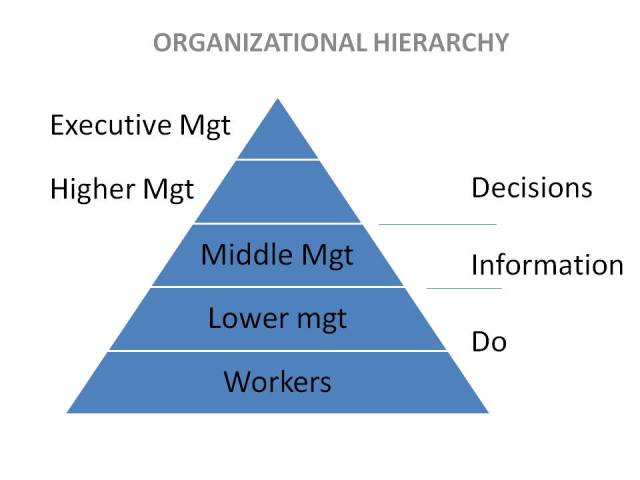
When the description above is combined with the three topics for every meeting as described in an earlier blog, you will notice that each of these levels of the corporate pyramid are focusing on one of the three levels, as shown in the picture below
Breadth of experience
Usually, a corporation has several requirements for Executives all geared towards grooming them broadly enough for general management instead of just one specialized field. These requirements often are also made explicit: they need to have spent at least x years abroad, they need to have worked in multiple businesses and in multiple areas of responsibility etc. Some enlightened companies even have the possibility to count taking care of a needing relative as well, but that is not the case everywhere.
Most organizations have nice generic statements that the new entrant can choose where to pursue a career, as a Specialist or a Generalist. Some even add Project Management as a possible third career path.
Spoiler: generally, neither is completely true. The first myth is that Project Management would offer an equivalent career path as Generalists. Despite what some glossy corporate brochures might say, in practice, pure Project Managers can get up to a middle management level, but to progress higher you will need General Management skills. Project Management skills might help you perform, but that is all.
The second, broader spread-myth is that Specialists might have similar chances of advancement as Generalists. That is about true as the statement that a carpenter may earn as much as a manager: it only works if the carpenter learns general management or entrepreneurial skills. Most specialists also get stuck in the middle management layer. If you want to get an idea of what kind of specialists might make it to the top: look at the Management Board. Almost always, General Management and Sales will be represented. Less frequently Finance, maybe HR, maybe IT. If there is a picture of the Process Landscape, usually there are 3 layers, with the core process in the middle. Look at which processes are depicted on top, as “Management Processes” as opposed to “Support Processes” at the bottom. Now which Specialists have a heavy say in the organization, do you think?
Management Development
Against this backdrop, new entrants are initially scanned into three categories:
- Anybody with no university goes towards the lower management and workers.
- Anybody with a university degree goes towards middle management
- And a very few of the university degree entrants are selected as a high potential, or hipo.
Hipo’s typically are given a middle management or staff position. Ideal is to start as assistant of a Board member, where you get a first row seat on the major corporate decision making and where you can develop your relationships with the top brass. Crucial here is to get a ‘mentor’ who will take a personal interest in your development and where you can go and ask in moment of utter bewilderment.
To develop their potential, hipo’s need to obtain a broad array of skills and are sent around to different divisions. In that process, several of them just turn out to not have the skills required for the next step and they will get stuck or leave the company. Others get moved to just that area of expertise that they can not master. Whether that is true because of real skill gaps or character deficiencies or pure bad luck does not matter. Those are the victims of the ‘horizontal Peter principle’. Only those that avoid this pitfall make the step to the top and enter the “C-suite”.

 Peter Alderliesten's Blog