
INTRODUCTION
Most of us will agree that privacy of individuals by itself is good, and the maintenance of privacy should be the starting point, only to be denied if there are reasons for the greater good, usually having to do with the police and security. However, pure privacy among individuals without any transparency has it’s limitations.
Note: Below the focus will be on the relationships among individuals, so not on the relationship between individual citizens and governments.
PROBLEM
There are a multitude of situations where extreme privacy leads to unwanted effects. Below just a few examples:
- High school kids can be approached by pedophiles who pretend to be much younger than they really are. On the one hand, one would want full transparency on the adult, whereas the child should definitely have it’s privacy protected so e.g. the pedophile does not know the child’s home address
- In the connected marketplace all kinds of platforms allow individuals to exchange goods and money, from eBay and Amazon to Uber. These platforms have their own support structure to try and prevent scams and crimes, but how do I as a person know that I am safe being picked up by an Uber-cab? (The same applies to a Yellow Cab, but somehow that does not seem to appeal to reader’s fears as much.) According to Forrester, http://bit.ly/1RfokVm Facebook estimates 2% of it’s accounts are fake, Twitter 5%, whereas Linked can not say. That would mean that approx 31 million fake Facebook accounts exist, despite an active identification policy against them.
- Not only our commercial, but also our private lives are moving into the internet. Most relationships in Western Europe are currently started via an electronic dating site according to some sources. In these ‘arena’s’ ultimate privacy also has some drawbacks: (mostly) female daters against aggressive (mostly) males; male daters against prostitutes/webcam girls/rip-off dating sites/automated&fake dating profiles; callgirls against aggressive customers; male grooms against fake foreign country brides, to name only a few obvious ones.
ANALYSIS
In all of the cases mentioned above, a balance between privacy and transparency needs to be found. A possible solution would be if there were a mechanism to link individuals with one another whereby a triangle is set up:
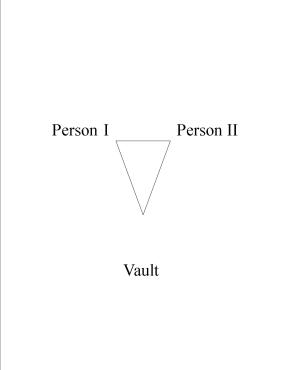
In the relationship between the individuals, absolute privacy is maintained, whereas both individuals have a transparent relationship with The Vault. Individual I has disclosed her real identity (how far this should go with respect to name, address, bank account number etc. is a separate issue) and Individual II has done the same with his.
This set-up would provide 2 main services to both parties involved:
- Person I can verify that Person II is a ‘real’ person to decide whether to even consider the interaction
- In case the individuals engage in a social or economic interaction, notify The Vault of the ‘transaction’. In case anything goes wrong, the Vault will provide the information to the police.
Such a ‘Vault’ would require an organization with an infrastructure. After speaking to several parties ‘in the field’ it became clear that such an organization may not be a commercial one, since commercial considerations of that company might override the privacy requirements. At the same time, it also became clear that such an organization may not be a governmental institution, since political considerations might then lead to the same effect. Therefore, the vehicle for this organization should be a non-profit.
ACTION?
The words above are all nice and well, but they do not prove that there is an actual need for this non-profit with the working name “The Vault”. If anything comes from this, first a larger “demand” needs to be established.

 Peter Alderliesten's Blog